
Oil Speaks Before Your Machine Does: Meet Testonic WearSense™
Industrial machines rarely fail all at once. A bearing collapse, bearing seizure, gearbox stress, or unexpected shutdown of a large hydraulic system is usually the result of small changes developing over time. In the early stages, these changes may not appear as noise, vibration, or performance loss. However, the oil circulating inside the machine can begin carrying the signs of this process much earlier.
For this reason, machine oil should not be viewed only as a lubricant. Oil is also a technical indicator that carries information from friction surfaces, bearings, bushings, gears, and moving metal components. In other words, oil silently records the machine’s operating history and developing wear trends.
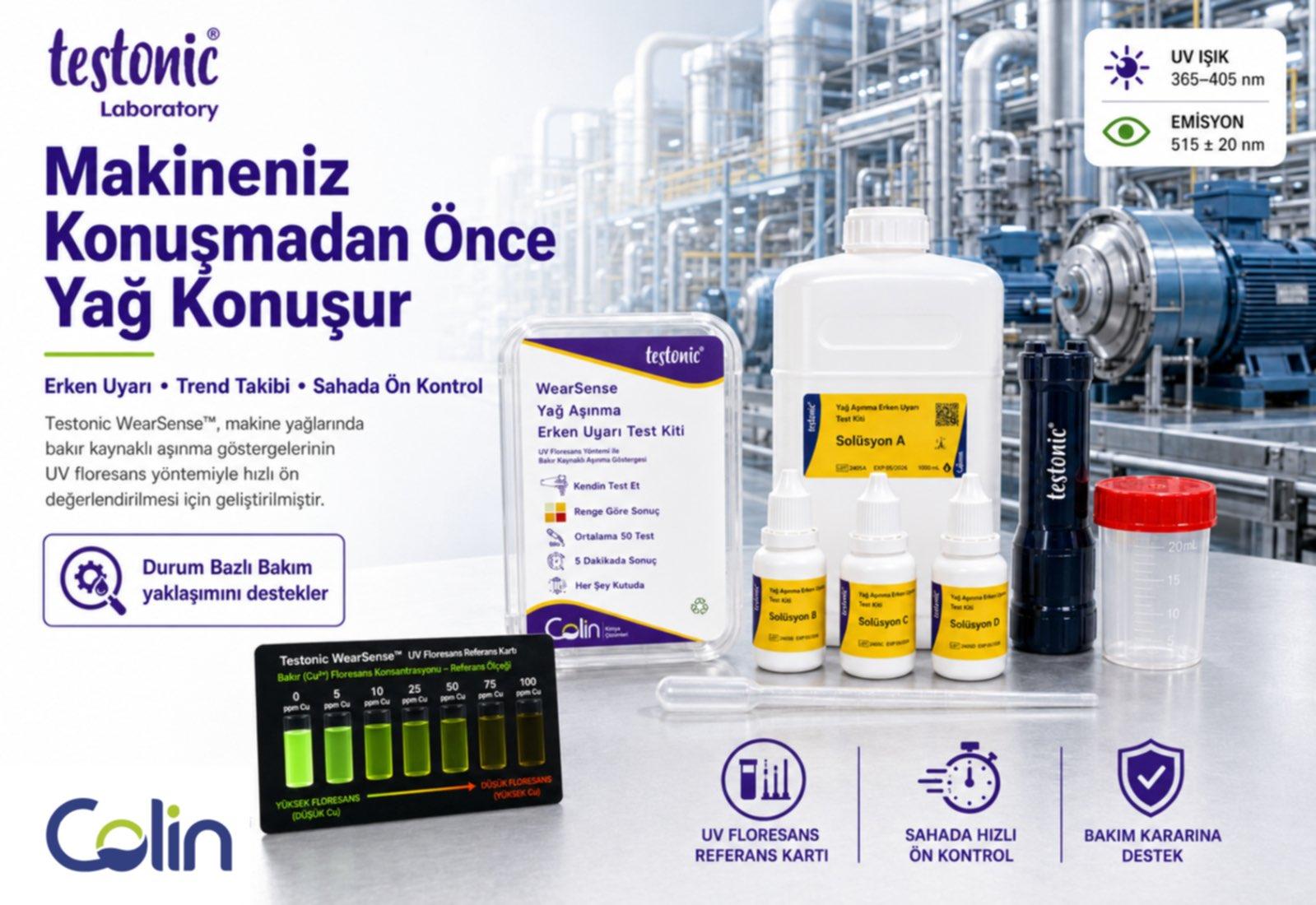
Testonic WearSense™ Oil Wear Early Warning Test Kit has been developed to help evaluate wear indicators in used oil quickly and directly in the field. The aim is not simply to determine whether the oil is contaminated; the real purpose is to understand what the oil is telling us about the machine.
Why Is Oil an Early Indicator of Machine Health?
When metal surfaces operate under load, a continuous friction and contact dynamic occurs between them. The oil film protects these surfaces, carries heat, reduces friction, and prevents direct damage between parts. However, as operating conditions become more demanding, as the protective capacity of the oil decreases, or as deterioration begins in a machine component, small amounts of metallic wear products may enter the oil.
At first, this wear is not visible. The oil may still look normal. The machine sound may not have changed. Vibration values may not yet have reached alarm levels. But metallic traces forming inside the oil can be among the earliest indicators of a mechanical problem that may grow over time.
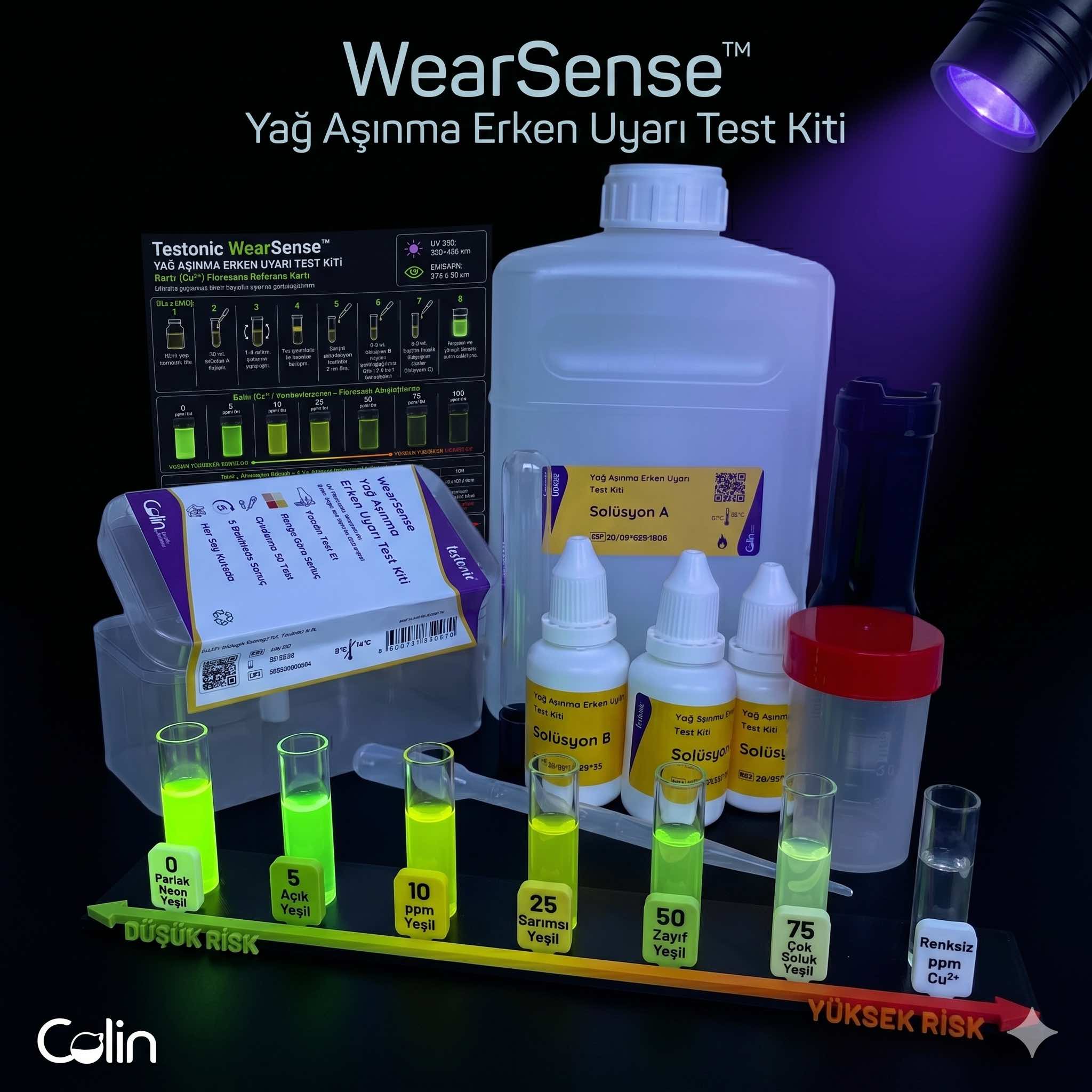
This is where Testonic WearSense™ comes into play. Based on calcein fluorescence technology, the system helps evaluate metallic wear indicators extracted from the oil. The fluorescence behavior observed under UV light provides rapid preliminary information about the metallic load in the oil.
Operating Hours Do Not Always Tell the Whole Story
In many facilities, oil replacement is still performed according to fixed operating hours. For example, oil may be scheduled for replacement after 500, 1,000, or 5,000 hours. This method is practical, but it does not always reflect the real condition of the machine.
Two machines operating for the same number of hours do not necessarily age in the same way. One machine may operate under low load, in a clean environment, and at stable temperature, while another may operate under heavy load, dusty conditions, temperature fluctuations, vibration, and intense mechanical stress. Even if the operating hours are identical, the oil condition and the level of wear inside the machine may not be the same.
Therefore, relying only on a calendar or operating hours brings two different risks. If the oil is replaced while it can still perform its function, unnecessary cost is created. On the other hand, if the oil has lost its protective capacity or wear has already started inside the machine, waiting for the scheduled maintenance time may allow a more serious failure to develop.
This is why Condition-Based Maintenance has become increasingly important in modern maintenance strategies. In this approach, the main question is not “How many hours has the oil been used?” but rather “What is the oil telling us about the machine right now?”
What Does WearSense™ Provide?
Testonic WearSense™ has not been developed to replace laboratory elemental analysis. It has been designed to provide maintenance teams with a fast, practical, and meaningful field-based preliminary evaluation. It is especially useful for facilities that want to understand whether an abnormal wear trend may be developing, make more informed oil replacement decisions, and reduce the risk of unexpected downtime.
The used oil sample is processed with the kit’s special extraction system. During this step, metallic wear indicators that may be present in the oil are transferred into the analysis phase. A fluorescence indicator is then added, and the result is evaluated under UV light. Strong fluorescence may indicate a lower metallic load, while significant fluorescence quenching may indicate increased metallic wear indicators in the oil.
This evaluation provides practical guidance for maintenance teams on questions such as:
Is the machine maintaining its normal operating behavior?
Is it too early or too late for an oil change?
Could there be an unexpected wear trend in bearings, bushings, or metal friction surfaces?
Is laboratory analysis or detailed mechanical inspection necessary?
In this way, WearSense™ supports maintenance decisions with a chemical field signal rather than relying only on assumptions or fixed intervals.
Not Just an Oil Change Test, but a Way to Listen to the Machine
It would be inaccurate to view WearSense™ only as a simple test that answers the question, “Should the oil be changed?” The product is part of a broader maintenance logic. Used oil carries traces of the mechanical processes occurring inside the machine. Monitoring these traces regularly can help understand the machine’s operating character.
A single sample taken from a machine provides a snapshot. However, oil samples taken from the same machine at regular intervals create much more valuable information. When changes in fluorescence behavior are monitored over time, it becomes easier to distinguish the machine’s normal operating pattern from abnormal wear trends.
Therefore, WearSense™ can be used both for one-time checks and as a monitoring tool within periodic maintenance programs. This allows facilities to move from a maintenance culture that reacts to failures toward one that seeks to detect failure signals before they become critical.
In Which Systems Does It Provide Value?
WearSense™ is not limited to a specific industry. It can be used for preliminary evaluation in many systems where oil is present, metallic friction surfaces operate, and downtime cost is significant.
Heavy equipment, production lines, gearboxes, hydraulic systems, generators, pumps, compressors, mining equipment, textile machinery, food and process industry equipment, conveying systems, marine applications, and large mechanical transmission systems are examples of areas where this approach can be used.
The common point is not the industry itself, but the risk:
If unexpected machine downtime is costly, reading the early signals carried by the oil is valuable.
Does It Replace Laboratory Analysis?
Testonic WearSense™ should not be positioned as a replacement for detailed laboratory analysis. ICP-OES, spectrometric oil analysis, and comprehensive tribological evaluations remain the most detailed methods. However, results from these analyses are not always available immediately in the field.
WearSense™, on the other hand, provides maintenance teams with a rapid preliminary evaluation. The result can help determine whether detailed machine inspection is required, whether oil replacement should be brought forward, or whether a sample should be sent for laboratory analysis.
The correct positioning is:
WearSense™ provides rapid field warning; laboratory analysis provides detailed confirmation when needed.
These two approaches are not alternatives to each other; they are complementary.
Conclusion: See the Signs Before the Machine Stops
Unexpected machine downtime is not only the cost of replacing a part. Production loss, service time, labor loss, spare-part waiting time, and sometimes cascading mechanical damage can make the total cost much higher.
For this reason, the most valuable maintenance is not the maintenance performed after failure occurs, but the intervention made while the signals that may lead to failure are still small.
Testonic WearSense™ Oil Wear Early Warning Test Kit treats machine oil not as waste or merely as a consumable to be replaced, but as a source of information about the internal condition of the machine.
Because, in many cases, oil speaks before the machine stops.
WearSense™ makes that language faster, more practical, and easier to understand in the field.