

Technical Overview
When a new viscose lot produces different results despite the same dyeing recipe, machine and process conditions, the cause does not necessarily lie in the dyeing process itself. Differences in sulfur-related residues originating from the manufacturing history of the viscose can be an important raw-material variable when investigating lot-to-lot variation, whiteness, yellow undertone, pretreatment behaviour, colour yield and shade reproducibility.
Contents
Why Are Sulfur-Related Residues in Viscose Important?
Viscose is a regenerated cellulose fibre. Unlike cotton, which is obtained directly as a natural fibre, viscose is produced through an extensive chemical manufacturing and purification process. For this reason, viscose entering a dyehouse should not be considered only in terms of physical properties; it should also be evaluated in relation to the chemical history carried over from its manufacturing process.
Post-production purification and washing stages are intended to remove process-related residues as effectively as possible. However, manufacturers, production lines, process-control practices and individual production lots are not identical. Commercial viscose materials can therefore differ in their sulfur-related residue profiles.
From the dyehouse perspective, the key issue is not simply whether sulfur-related residues are present. The more useful question is whether a newly received raw-material lot differs significantly from viscose lots that have previously performed reliably in the mill.
This is why sulfur control becomes particularly valuable in lot comparison, incoming raw-material control and root-cause analysis.
Why Can the Same Dyeing Recipe Produce Different Results with Different Viscose Lots?
One of the main objectives in textile dyeing is reproducibility. When the same article is produced again, the mill expects the same shade, comparable colour yield, similar ground colour and consistent process behaviour.
In practice, however, a situation such as the following is common:
- The same dyeing recipe is used.
- The same dyes and auxiliaries are used.
- The same machine and process parameters are applied.
- No major change is observed in water or operating conditions.
- Yet the result changes after the viscose lot is replaced.
In such a case, immediately modifying the dyeing recipe may make the actual root cause more difficult to identify. If one of the main changed variables is the raw material, the raw material itself should first be investigated.
If the same process previously worked reliably and problems began only after the viscose lot changed, could the new raw material be chemically different from the mill's proven reference lots?
How Should a Viscose Raw-Material Control Chain Be Established in a Dyehouse?
Rather than making a decision from a single analytical result, a stronger approach is to establish a control system that links incoming raw-material data with actual production performance.
Determine whether the newly received viscose lot differs from the mill's established raw-material profile.
Use viscose lots that have previously performed reliably as real production references.
Check washing, bleaching, whiteness and hydrophilicity performance of the new lot.
Evaluate colour yield, shade and levelness under the same dyeing recipe.
Link the result with supplier, lot number and actual production performance.
For Which Production Problems Should Sulfur-Related Raw-Material Variation Be Investigated?
Sulfur-related residues are not the sole cause of every dyeing problem. However, they can become an important investigation parameter when a quality issue appears after a raw-material lot change while the process itself remains unchanged.
| Observed Problem | Why Should the Raw Material Be Investigated? | How Should the Result Be Used? |
|---|---|---|
| Shade difference between lots | If the same recipe produces different results on different viscose lots, substrate variability should be investigated. | Compare the problematic lot with proven reference viscose lots. |
| Whiteness difference | Different ground shades after the same bleaching process may indicate a raw-material variable. | Evaluate sulfur-related results together with whiteness and hydrophilicity. |
| Yellow undertone | Repeated lot-specific ground-colour differences justify investigation of the raw-material history. | Compare the new lot with established reference lots. |
| Variation in colour yield | A different colour depth at the same dye dosage can also be related to substrate differences. | Link raw-material results with actual dyeing performance. |
| Loss of pretreatment reproducibility | The same washing or bleaching process may not produce identical results on every raw-material lot. | Determine whether the new lot deviates from the reference raw-material profile. |
| Problems following a supplier change | Viscose producers may use different manufacturing and purification conditions. | Track results by supplier and lot over time. |
Why Is a Reference-Lot Approach More Valuable Than Relying on a Single Limit?
The operational meaning of an analytical result becomes much stronger when it is linked with actual production performance.
Two theoretically similar raw materials may not behave identically in different fabric constructions or pretreatment systems. By contrast, viscose lots that have repeatedly delivered trouble-free production in the mill provide highly valuable practical references.
Where possible, reference lots should be selected from materials that have:
- Performed reliably in several production runs,
- Reached the required whiteness,
- Shown acceptable hydrophilicity,
- Reached the target dyeing shade,
- Provided consistent colour yield,
- Produced no recurring quality complaints.
How Should the Test Result Be Interpreted?
Classifying the result only as "high" or "low" is not sufficient. From a dyehouse perspective, three questions should always be considered together:
Does the new lot resemble raw materials that have previously delivered successful production?
Have whiteness, hydrophilicity or dyeing behaviour also changed?
Is a similar deviation observed repeatedly with the same supplier or production source?
| Result Profile | Engineering Interpretation | Recommended Action |
|---|---|---|
| Similar to reference lots | The sulfur-related raw-material profile appears comparable with previously successful production lots. | Proceed with the standard process and continue routine quality controls. |
| Different from the reference | May indicate a change in the raw-material profile. | Monitor pretreatment, whiteness and hydrophilicity more closely. |
| Significantly higher than the reference | Indicates that the new material differs clearly from established successful lots. | Consider controlled pretreatment and dyeing verification before full-scale production. |
| Variable within the same lot | Lot homogeneity or sampling representativeness should be investigated. | Compare material from different rolls, packages or locations within the lot. |
| Similar to reference, but production problem persists | Sulfur-related raw-material variation is less likely to be the primary explanation. | Shift the investigation towards sizing, oils, hydrophilicity, bleaching, water quality and dyeing parameters. |
What Should Be Done When the Result Is Higher Than or Different from the Reference?
A result that differs from the reference should not automatically be interpreted as "raw material rejected". It should instead be used as an early-warning signal.
Should the Dyeing Recipe Be Changed Immediately When a High Result Is Obtained?
No. Before changing the dyeing recipe, it should first be determined whether the raw-material difference is actually reflected in the process performance.
For example:
- The sulfur-related result may differ from the reference while whiteness, hydrophilicity and dyeing behaviour remain normal.
- The result may differ and whiteness or hydrophilicity may also change.
- The result may be similar to the reference while the shade problem continues.
These three scenarios should not be managed in the same way.
Why Should Sulfur, Bleaching and Hydrophilicity Be Evaluated Together?
These controls answer different quality-control questions and therefore should not be considered alternatives to one another.
| Control | Primary Question | Process Meaning |
|---|---|---|
| Sulfur Control in Viscose | Is the new raw material different from the reference viscose? | Helps investigate chemical variability originating from the raw material. |
| Hydrophilicity Control | Does the fabric wet rapidly and uniformly after pretreatment? | Evaluates actual surface performance of the fabric after pretreatment. |
| Bleaching Control | Has the pretreatment and bleaching process produced the required result? | Supports evaluation of process performance before dyeing. |
If a new lot has a sulfur-related result different from the reference, lower whiteness and poorer hydrophilicity, the relationship between raw material and pretreatment performance should be investigated more closely.
By contrast, if sulfur-related results, whiteness and hydrophilicity are all comparable with the reference but the dyeing problem continues, the investigation should shift towards dyes, auxiliaries, water quality, pH, salt/alkali profile, process temperature, time and machine conditions.
What If the Result Is Similar to the Reference but the Dyeing Problem Continues?
This is still a useful analytical outcome because it makes sulfur-related raw-material variability a less likely primary cause.
The investigation can then be redirected towards:
- Sizing and desizing performance,
- Oil or process residues,
- Hydrophilicity,
- Bleaching conditions,
- Water hardness and metal ions,
- pH and alkalinity,
- Dye and auxiliary dosage,
- Machine circulation and loading conditions,
- Temperature and time profile.
The value of a test does not come only from confirming a suspected cause. Helping to deprioritise an unlikely cause can also narrow the root-cause investigation considerably.
How Should Supplier and Lot Performance Be Monitored?
One of the most valuable operational uses of sulfur control is converting individual results into long-term raw-material performance data.
| Parameter to Record | Why It Matters |
|---|---|
| Supplier | Allows long-term comparison of different raw-material sources. |
| Lot number | Links production problems to a specific production batch. |
| Sulfur-related result | Tracks variability in the raw-material chemical profile. |
| Whiteness | Helps determine whether raw-material differences are associated with bleaching performance. |
| Hydrophilicity | Shows actual fabric behaviour after pretreatment. |
| Dyeing result | Links laboratory control data with actual production performance. |
| Correction / reprocess requirement | Shows which raw materials create additional process cost or correction demand. |
Once sufficient data has been collected, purchasing decisions can be based not only on price and delivery performance but also on the real process consistency and operational cost of the raw material in the mill.
Example Dyehouse Scenario: Shade and Whiteness Change After a New Viscose Lot
Consider a mill that has been producing the same viscose article with the same recipe over a long period.
After a new raw-material lot arrives, the following changes are observed:
- The ground shade after bleaching is slightly more yellow,
- The dyeing shade moves away from the reference standard,
- Colour yield differs from previous lots,
- No important change is found in machine or recipe records.
What Does the Testonic Sulfur Detection Test Kit for Viscose Provide in This Control System?
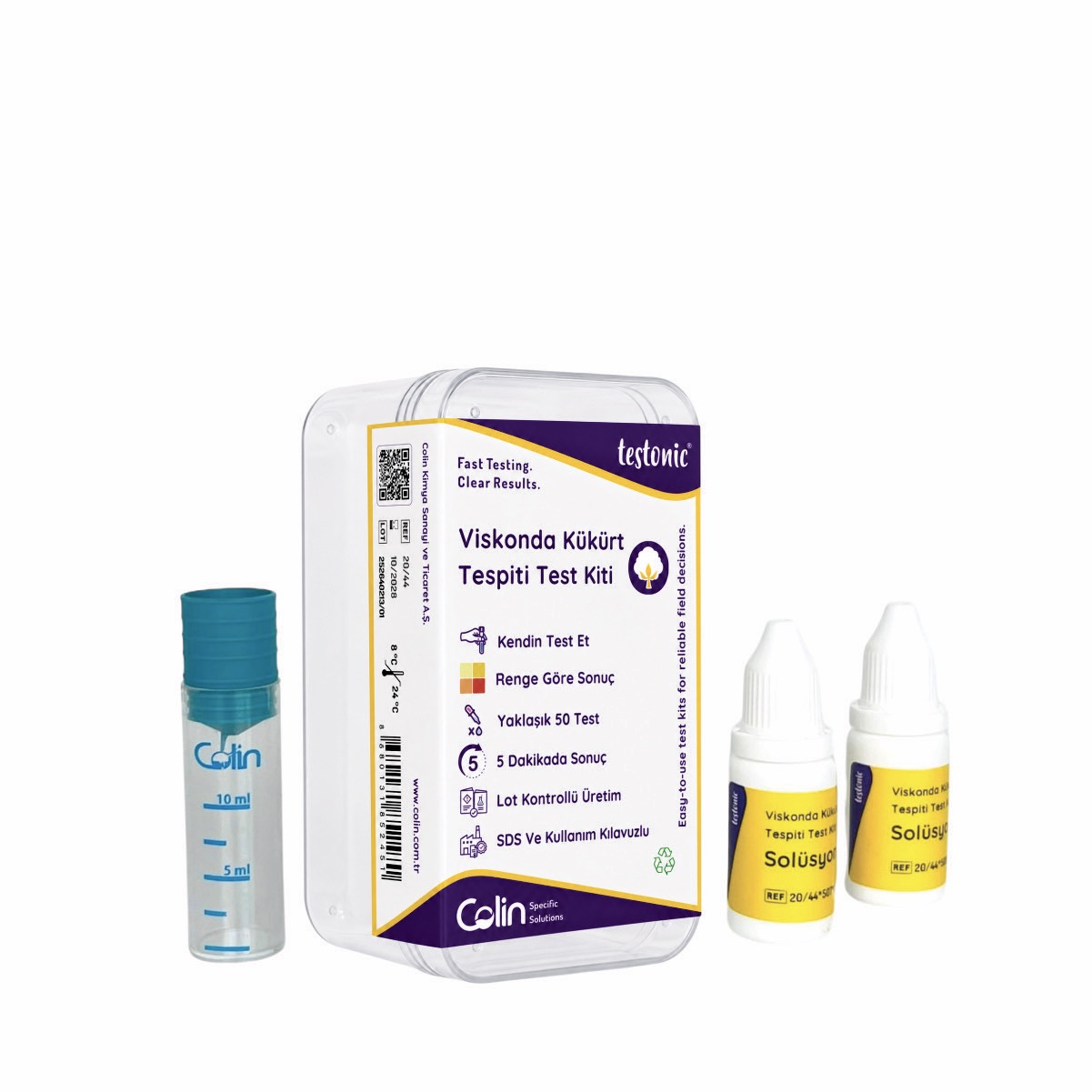
Testonic Sulfur Detection Test Kit for Viscose is intended for evaluating sulfur-related residue differences in raw viscose yarn, knitted fabric and woven fabric and for comparing viscose lots.
From a dyehouse perspective, its primary value is helping answer practical quality-control questions such as:
- Is the new viscose lot different from raw materials that have previously performed reliably?
- Is there a systematic difference between the problematic lot and the reference lot?
- Has a supplier change also changed the raw-material profile?
- Did the bleaching or dyeing problem appear at the same time as the raw-material change?
- Should the new lot proceed directly to full-scale production, or should a controlled production verification be performed first?
This allows the test to become more than a laboratory check used only after a problem occurs. It can form part of incoming raw-material control, lot monitoring, supplier-performance evaluation and pre-dyeing risk management.
Frequently Asked Questions
Conclusion
Reproducibility in viscose dyeing and finishing depends on more than the accuracy of the dyeing recipe. The consistency of the raw-material lots entering the process is equally important.
Monitoring sulfur-related residue differences in viscose can reveal a raw-material variable that might otherwise be overlooked, particularly when a new lot behaves differently under otherwise unchanged process conditions.
The strongest quality-control approach is not to interpret the result simply as "high" or "low", but to evaluate it together with reference lots, whiteness, hydrophilicity, pretreatment performance and actual dyeing behaviour.
With this approach, quality control can move from reacting to problems after they occur towards identifying raw-material variability before production and managing process risk more proactively.
Reliable Dyeing Control Starts with the Raw Material
Compare each new viscose lot with proven reference materials and evaluate sulfur-related results together with bleaching, hydrophilicity and actual dyeing performance to establish a mill-specific viscose quality profile.