

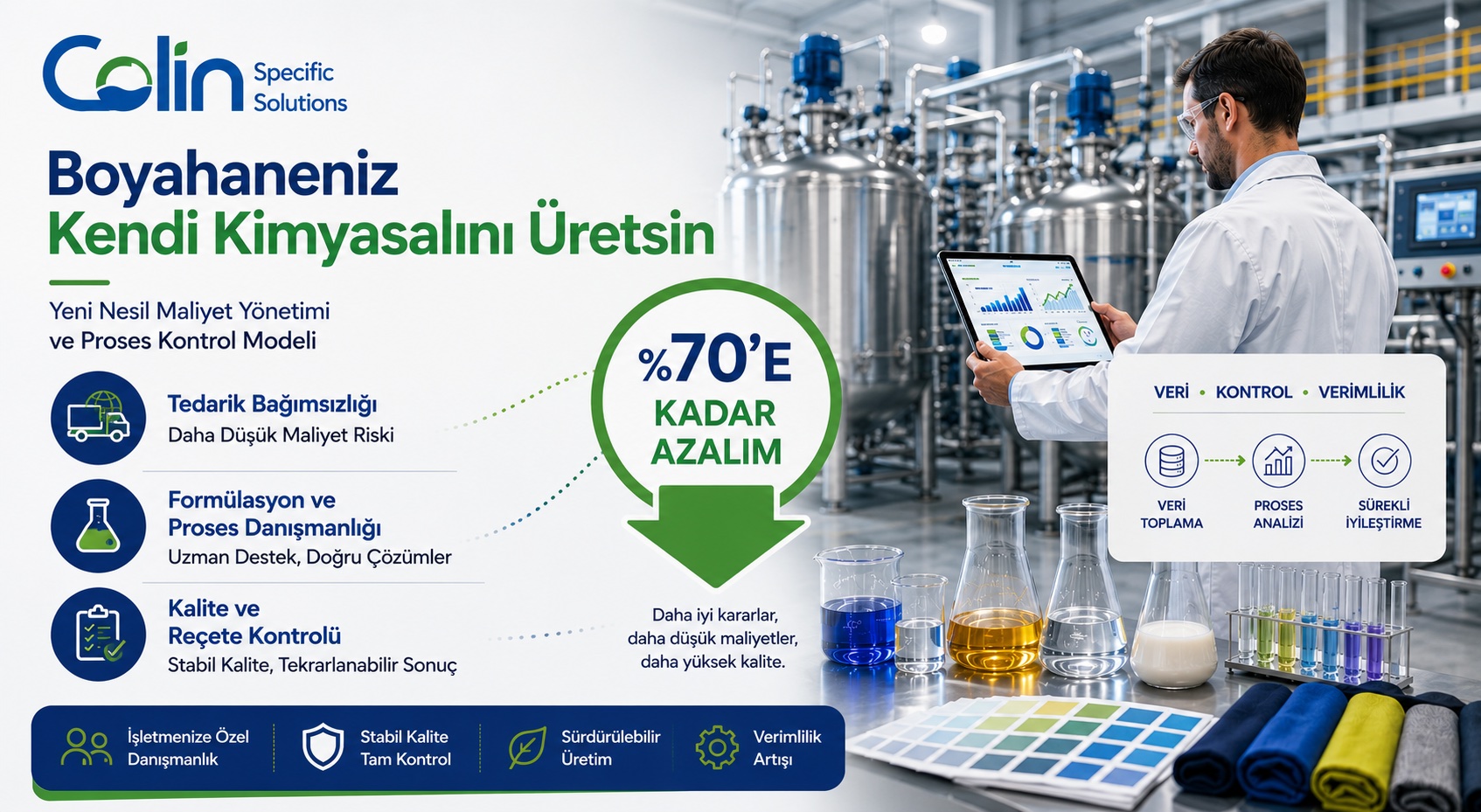
Let Your Dyeing Plant Produce Its Own Chemicals
New Generation Cost Management and Production Independence Model in Textile Auxiliary Chemicals
The textile sector has faced increasing energy costs, rising labor expenses, currency fluctuations, and uncertainties in raw material prices in recent years. The common characteristic of businesses that can remain competitive in this environment is not only that they reduce their production costs, but also that they reduce their dependence on foreign sources in critical processes. For dyeing plants, auxiliary chemicals are at the forefront of these critical areas. Today, in many textile businesses, auxiliary chemical expenses constitute a significant portion of total finishing costs. However, most businesses are unaware of the true cost structure of the products they use, struggle to manage quality changes, and are forced to re-optimize their production processes with each new supplier change.
As Colin Kimya, an organization that has been developing and producing textile auxiliary chemicals for over 25 years, we support businesses in establishing auxiliary chemical production systems within their own organizations.
Our goal is not just to reduce costs.
Our goal is;
-
To ensure chemical independence,
-
To establish quality standards within the business to carry,
-
To preserve corporate memory,
-
To reduce supply risks,
-
To make production processes more predictable,
-
To create a long-term competitive advantage.
Why Should Your Dyeing Factory Produce Its Own Chemicals?
1. The Majority of Auxiliary Chemicals; Actually, it can be produced
Many products used in the textile industry
-
Ion traps
-
Wetting agents
-
Dispersants
-
Neutralization products
-
Peroxide stabilizers
-
Washing products
-
Foam cutters
-
Equalizers
-
Soaping products
-
Buffer systems
They consist of combinations of a limited number of raw materials in different ratios.
Therefore, many products can be produced within the plant with a much lower investment than expected.
2. Costs Can Be Reduced by Up to 70%
When purchasing ready-made chemicals, not only the product price is paid.
In fact, the following costs are also purchased:
-
Brand cost
-
Packaging cost
-
Transportation cost
-
Financing cost
-
Dealer profit
-
Manufacturer profit
In production within the business, these costs are significant. The section is eliminated.
In a properly planned system, savings of 40–70% can be achieved in total auxiliary chemical costs.
3. Quality Control Becomes Easier
Many businesses experience the following questions with each new product purchase:
-
Is this batch the same as the previous batch?
-
Supplier formula Did it change?
-
Why is the product behaving differently?
-
Why is it foaming more?
-
Why did the color tone change?
Every new product actually means quality control again.
When you use your own recipes, the quality standard is established within the business and the process becomes much more predictable.
4. Business Memory is Preserved
One of the problems frequently encountered in the textile sector is this:
The production manager changes.
The purchasing manager changes.
The laboratory supervisor changes.
Then the products used begin to change.
The accumulated knowledge over the years is lost.
Conclusion; As such, the business transforms into a constantly relearning organization.
In businesses that establish their own chemical system, the knowledge remains in the system, not with individuals.
5. Supplier Risks are Reduced
Many businesses face the following problems:
-
Extended supply time
-
Product unavailability
-
Quality changes
-
Price increases
-
Distributorchanges
The production model covers a significant portion of these risks; eliminates.
Why is Colin Kimya's Approach Different?
Many companies in the market only sell products.
We, on the other hand, build systems.
For over 25 years;
-
Reactive dyeing
-
Disperse dyeing
-
Acid dyeing
-
Product treatment
-
Bleaching
-
Neutralization
-
Water conditioning
-
Complexan (Ion-capturing, masking) technologies
Thanks to the studies we conduct in these fields, we offer not only product information but also process information.
As a result of these studies;
-
Numerous papers presented at national textile congresses,
-
University-industry collaborations,
-
Scientific publications,
-
Field applications
Supported by We have established a strong technical infrastructure.
How Much Investment is Required for Installation?
The answer to this question often surprises businesses.
Many dye houses think that large reactors and high investment are required for the production of auxiliary chemicals.
In reality, the initial investment for a business that consumes approximately 1 million USD worth of auxiliary chemicals annually is often:
10,000 – 25,000 USD
remains in this range.
This investment is generally:
-
Mixing tank
-
Transfer pump
-
Simple QC equipment (Generally found in paint shops)
-
Storage space
is limited to.
In most facilities, a single operator is sufficient.
Which products can be produced within the plant?
For example:
-
Complexants (Ion scavenger, Masking agents)
-
Peroxide stabilizers
-
Wetting agents
-
Detergents
-
Soaping products
-
Neutralization products
-
Buffer systems
-
Disperse aids
-
Washing products
-
Alkaline systems
-
Foam Cutters
-
Equalizers
Among the product groups that can be produced within the plant.
Frequently Asked Questions
Is it necessary to build a separate factory for chemical production?
No.
In most dye houses, a small portion of the existing areas; It can be organized as a production area.
Many personnel are needed for production.
Is there?
No.
In most cases, a single operator is sufficient.
Do the recipes belong to the company?
Yes.
Once the system is established, the recipes become part of the company's memory.
Does quality decrease?
On the contrary.
When the right system is established, quality generally becomes more stable.
Is it necessary to constantly develop new products?
No.
However, by following developments in the sector, more economical and efficient systems can be developed.
can be passed.
Can new technologies like salt-free dyeing be applied?
Yes.
New generation processes can be integrated into the existing system when appropriate.
What is the payback period of the investment?
Depending on the company's consumption, the payback period is expressed in months in most projects.
Conclusion
Buying chemicals is no longer just a purchase decision.
This decision;
-
Cost,
-
Quality,
-
Corporate memory,
-
Supply security,
-
Competitiveness
directly affects.
Dyehouses that can produce their own auxiliary chemicals not only achieve lower costs; they also take control of the quality standard and become much stronger in the long run.
It will have a production infrastructure.
Colin Kimya, with over 25 years of experience in textile auxiliary chemicals, R&D infrastructure and scientific approach, supports your business in confidently realizing this transformation.