


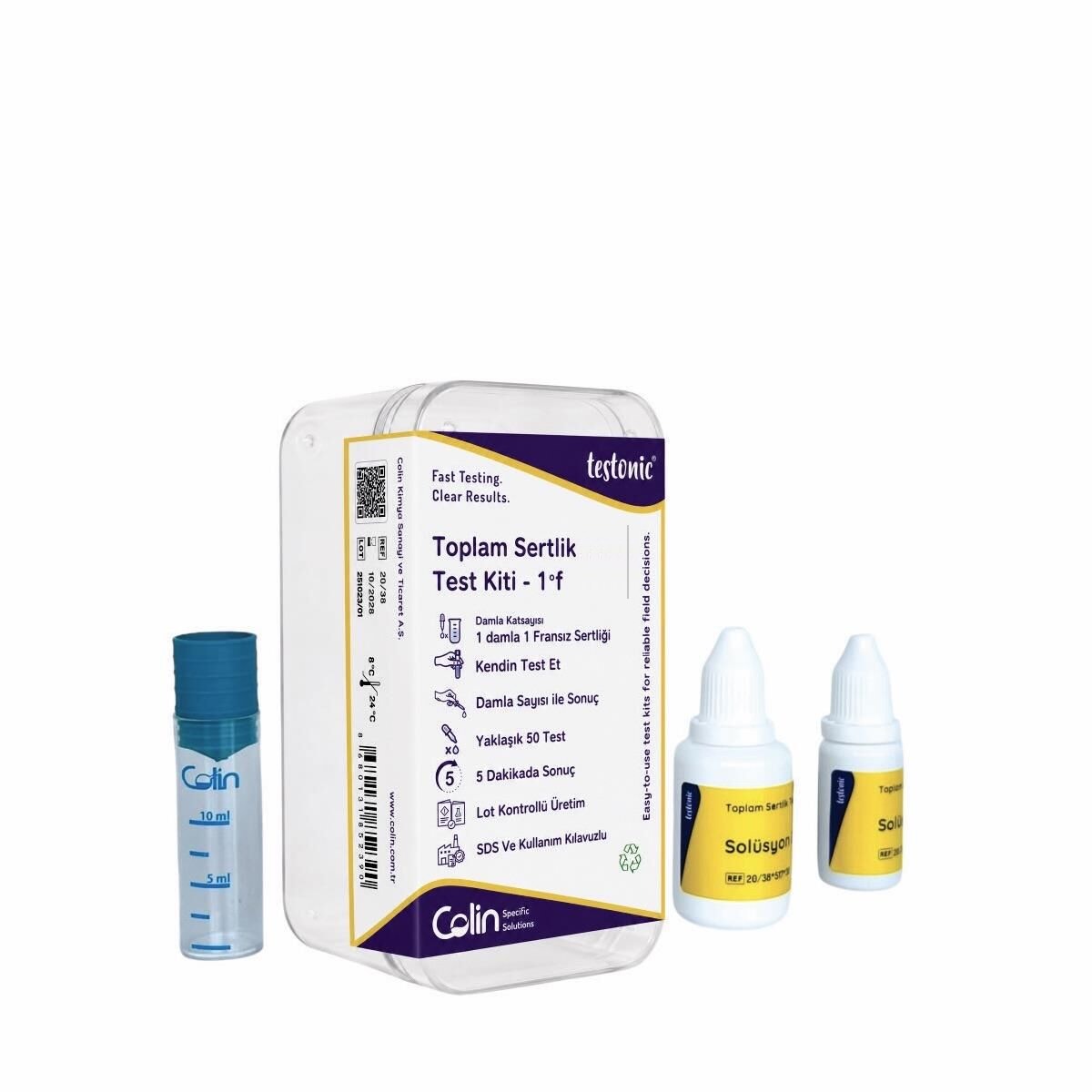
Testonic® Total Hardness Test Kit (1°f) is designed for the rapid determination of total water hardness (calcium and magnesium ions) in water samples. It enables on-site monitoring of scale-forming minerals in municipal, well, boiler, cooling tower, and soft water systems to protect industrial equipment from scaling.
Based on a titrimetric (drop-count) method, this kit eliminates the need for expensive analytical instruments or specialized laboratory training. By tracking the precise drop-by-drop color change in the sample, you can obtain accurate hardness measurements within minutes.
It is suitable for verifying water softener efficiency, inspecting industrial process streams, and ensuring heating systems operate reliably without calcium fouling.
Why Is It Important?
Dissolved calcium and magnesium ions precipitate under heat and pressure, leading to mineral scale deposits, restricted fluid flow, and severe heat transfer inefficiencies. This test kit provides instant on-site data to evaluate softener resin saturation, prevent fouling, and maintain optimal chemical treatment regimens.
Testing in 3 Simple Steps
- Prepare the Sample: Fill the clean graduated test vial with the water sample up to the designated mark.
- Perform the Test: Add the indicator solution to develop the initial color, then add the titration reagent drop by drop while gently swirling the vial.
- Read the Result: Count the drops until the color transition is complete; each drop corresponds directly to 1 French Degree (°f) of total hardness.
Package Contents
- Total Hardness Test Solution A
- Total Hardness Test Solution B
- Graduated Test Tube
- Instruction Manual
Total water hardness is primarily caused by dissolved calcium (Ca2+) and magnesium (Mg2+) ions. Under suitable temperature and chemical conditions, these ions can contribute to mineral scale formation. Therefore, total hardness analysis is an important water quality control parameter in water softening, treatment, boilers, cooling systems, and industrial processes.
The Testonic® Total Hardness Test Kit (1 °f) uses a drop-count titrimetric method that enables convenient measurements in the field or laboratory without analytical instruments. The number of titrant drops required to reach the indicator colour-change endpoint directly represents the total hardness value, with each drop corresponding to 1 French degree of hardness.
Analytical Principle
The measurement is based on the combined response of hardness-forming ions during titration. An indicator produces a visual colour change at the titration endpoint. The number of titrant drops added to the sample is converted into a hardness value using the specified drop factor.
Results are expressed in French degrees of hardness (°f). The method determines the combined hardness contribution of calcium and magnesium rather than their individual concentrations.
Direct numerical results make the kit suitable for comparing different water sources, evaluating treatment performance, and monitoring changes in hardness over time.
What Is It Used For?
Knowing the hardness level of water helps operators monitor water conditioning processes. Under certain conditions, calcium and magnesium can contribute to mineral deposits in pipelines, heat exchangers, boilers, and heating surfaces. Such deposits may reduce heat transfer efficiency, restrict water flow, and increase maintenance requirements.
Total hardness measurement is one of the fundamental tests used to evaluate these conditions. Regular testing supports water softening performance monitoring, source water comparison, and industrial process water quality control.
Main applications:
- Water softening systems: Comparing inlet and outlet hardness to monitor resin performance, hardness removal, and regeneration requirements.
- Reverse osmosis (RO) systems: Checking feedwater hardness and assessing pretreatment performance.
- Steam boilers: Monitoring feedwater hardness and supporting water conditioning programmes.
- Cooling towers: Monitoring circulating water hardness and evaluating mineral deposition risks.
- Textile dyeing and finishing: Controlling hardness in dyeing, washing, and chemical processing water.
- Municipal, well, and spring water: Comparing hardness levels from different water sources.
- Aquariums and aquaculture: Monitoring general hardness (GH).
- Industrial cleaning: Evaluating hardness-related effects on detergent consumption and cleaning processes.
How Does the Test Work?
Drop-count titration is a practical method that does not require specialized analytical instruments. Testing involves three main steps.
These steps describe the general testing principle. The instruction manual should be followed for reagent quantities, sample volume, and endpoint identification.
Technical Specifications
| Measured parameter | Total water hardness caused by calcium and magnesium ions |
| Analytical method | Drop titration with a visual colour-change endpoint |
| Drop factor | 1 drop = 1 °f = 10 mg/L CaCO3 |
| Nominal reading increment | 1 °f |
| Suitable samples | Municipal, well, treated, process, boiler, and cooling water |
| Instrument requirements | No laboratory measuring instruments required |
| Analysis time | Approximately 5 minutes |
| Test capacity | Approximately 50 tests |
| Storage conditions | 8–24 °C, in closed packaging |
| Package contents | Indicator solution, 1 °f titrant solution, graduated test tube, and instruction manual |
Calculation of Results
The French degree of hardness (°f) expresses total hardness as a calcium carbonate (CaCO3) equivalent.
Total Hardness (°f) = Number of Titrant Drops × 1
For example, if the colour-change endpoint is reached after 18 drops:
- Total hardness = 18 °f
- CaCO3 equivalent = 180 mg/L
- German hardness equivalent ≈ 10.1 °dH
Common hardness conversions:
- 1 °f = 10 mg/L CaCO3
- 1 °f ≈ 0.56 °dH
- 1 °dH ≈ 1.79 °f
Results should be compared with the target hardness requirements of the relevant water system. Total hardness alone does not establish drinking water suitability or fully determine scaling potential.
Water Hardness Classification
Water may be classified as soft, moderately hard, or hard based on its hardness concentration. However, classification limits vary between reference systems and applications.
The following table presents an example based on the drinking water hardness categories published by the UK Drinking Water Inspectorate (DWI), converted into French degrees of hardness.
| Hardness (°f) | CaCO3 (mg/L) | Classification |
|---|---|---|
| Up to 10 °f | Up to 100 | Soft |
| 10–15 °f | 100–150 | Slightly hard |
| 15–20 °f | 150–200 | Moderately hard |
| 20–30 °f | 200–300 | Hard |
| Above 30 °f | Above 300 | Very hard |
Source: Drinking Water Inspectorate – Water Hardness.
This classification does not establish acceptance limits for industrial water treatment systems. Permissible hardness levels in boilers, cooling systems, and other processes depend on equipment specifications and operating requirements.
Analytical Interferences and Measurement Limitations
Drop-count titration results can be affected by the chemical characteristics of the sample. The following factors should be considered, particularly when analysing industrial process water with compositions different from ordinary water samples:
- Colour and turbidity: Strongly coloured or turbid samples may make it difficult to identify the indicator endpoint.
- Other metal ions: Certain metal ions may interfere with titration depending on their concentrations and the analytical conditions.
- Complexing agents: Chemicals that bind hardness ions may cause deviations in measured results.
- pH: Strongly acidic or alkaline samples may affect endpoint detection.
- Low hardness concentrations: The nominal 1 °f reading increment may not provide sufficient differentiation at very low hardness levels.
For samples containing metal-binding water treatment chemicals, measurement suitability should be verified with an appropriate reference laboratory method when necessary.
Which Water Test Should I Choose?
A complete water quality assessment may require monitoring parameters other than total hardness, including alkalinity, chloride, corrosion inhibitors, and oxygen scavengers. The appropriate test should be selected according to the parameter being monitored.
| Parameter | Related Test | Monitoring Purpose |
|---|---|---|
| Total Hardness | Total Hardness Test Kit (1 °f) | Measurement of calcium and magnesium hardness |
| Carbonate Hardness / Alkalinity | KH Test Kit | Carbonate-bicarbonate alkalinity and buffering capacity monitoring |
| Sulfite | Sulfite Test Kit | Monitoring residual sulfite oxygen scavenger in boiler water |
| Molybdenum / Molybdate | Molybdenum Test Kit | Monitoring molybdate-based inhibitor levels in cooling systems |
| Chloride | Chloride Test Kit | Chloride concentration and water quality monitoring |
Replacement Solutions and Complementary Products
Individual kit components are available separately for facilities performing routine hardness measurements. This allows existing measuring tubes and accessories to remain in use.
| Requirement | Related Product | Description |
|---|---|---|
| Replacement Titrant | Total Hardness Titrant Solution (1F) | Replacement titrant for hardness measurement with a 1 °f drop factor |
| Replacement Indicator | Total Hardness Indicator Solution | Indicator for visual determination of the titration endpoint |
| Multi-Parameter RO Monitoring | RO System Control Kit | Combined monitoring of different water quality parameters in RO systems |
Important Usage Notes
- Use a clean water sample and measuring tube.
- Maintain the sample volume specified in the instruction manual.
- Hold the dropper vertically and count drops consistently.
- Mix the sample adequately after each drop.
- Determine the result according to the specified colour-change endpoint.
- Higher hardness concentrations require more titrant, so the total number of available tests may vary.
Frequently Asked Questions
1. Is hard water safe to drink?
Water hardness alone does not determine whether water is safe or unsafe to drink. Calcium and magnesium are naturally occurring minerals. However, drinking water suitability must also be assessed using microbiological and other chemical quality parameters.
2. What is the ideal hardness of drinking water?
There is no single ideal hardness value applicable to all drinking water. Hardness affects mineral composition and scaling potential. Water quality should be evaluated according to its intended use and other relevant parameters.
3. Does boiling water completely remove hardness?
No. Boiling may reduce some temporary hardness associated with bicarbonates through mineral precipitation. However, it does not remove all calcium and magnesium compounds responsible for total hardness.
4. How can I check whether my water softener is working?
Compare hardness measurements taken before and after the softening unit. Increasing outlet hardness may indicate that resin performance or regeneration conditions need attention. Applications requiring very low residual hardness may benefit from a test with a smaller reading increment.
5. What is the difference between hardness and TDS?
Hardness primarily represents calcium and magnesium ions, whereas TDS relates to total dissolved substances. Conductivity-based TDS meters do not directly measure hardness. For example, ion-exchange softening may significantly reduce hardness without producing an equivalent decrease in TDS.
6. How many ppm is 1 French degree of hardness?
One French degree (1 °f) equals 10 mg/L expressed as CaCO3. For example, a titration requiring 15 drops corresponds to 15 °f, equivalent to 150 mg/L total hardness as CaCO3.
For Textile Finishing and Dyeing Businesses
It ensures proper color retention in dyeing processes by determining water quality.
For Drinking Water Production Facilities
It measures the hardness of water by determining the calcium and magnesium levels in drinking water and verifies that the water has undergone appropriate purification processes.
Pollution Monitoring and Water Quality Testing for Environmental and Wastewater Management
It is used to assess the environmental impacts of water by analyzing the hardness level in wastewater.
Test and Process Control Kits for Textile Finishing and Dyeing Mills
Helps monitor calcium-magnesium hardness in process water and dye bath preparation, supporting control of dye uptake, spotting and scale-related risks.
Technical Documents
Related Posts
Related News
Technical Support and Product Consulting
Customer Questions & Expert Answers
About total hardness measurement in textile dyeing
Salt Solution Preparation
You can ask us about the product.


