


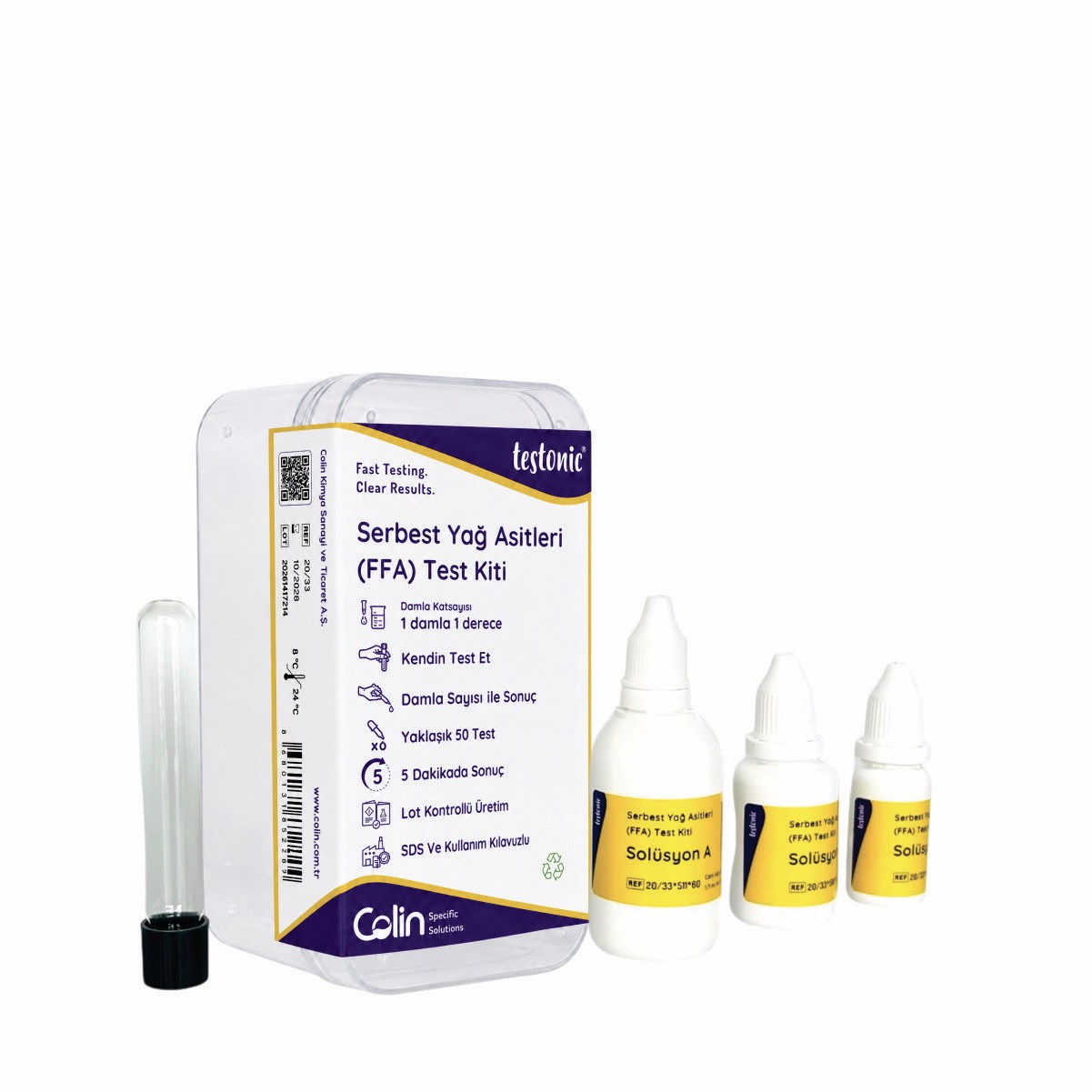
Testonic® Free Fatty Acids (FFA) Test Kit is a practical, drop-count-based test kit designed for quick and easy measurement of free fatty acids in frying oils and suitable edible oils.
Ideal for restaurants, hotels, catering businesses, professional kitchens and food production facilities, the kit simplifies routine oil acidity monitoring. It provides results in approximately 5 minutes without requiring a measuring instrument. Each titration drop corresponds to 1 FFA degree.
Why Is Free Fatty Acid Monitoring Important?
During frying, oils undergo changes caused by heat, moisture and contact with food. These conditions can increase free fatty acid levels. FFA testing helps monitor oil acidity, compare different stages of use and simplify routine quality control.
How to Measure FFA
Allow the oil sample to cool safely and transfer the specified amount into the test tube according to the instructions.
Add the test solutions in the specified order. Count the drops used during titration.
Complete the test at the specified colour change. The number of titration drops indicates the FFA degree.
Kit Contents
- Solutions A, B and C
- Capped test tube
- Instructions for use
Testonic® Free Fatty Acids (FFA) Test Kit
Testonic® Free Fatty Acids (FFA) Test Kit is a practical, drop-count-based test kit designed for quick and easy determination of free fatty acid levels in frying oils and suitable edible oils.
Ideal for restaurants, hotels, catering businesses, professional kitchens and food production facilities, the kit simplifies routine oil acidity monitoring. It provides results in approximately 5 minutes without requiring laboratory instruments. Each titration drop corresponds to 1 FFA degree.
Analytical Principle
The test is based on the principle of acid-base titration. Free fatty acids present in the oil sample are titrated using the test solutions until the specified colour-change endpoint is reached.
The number of titration drops required to reach the endpoint indicates the FFA level according to the kit's own degree scale. This allows practical testing without a burette, automatic titrator or additional measuring instrument.
1 titration drop = 1 FFA degree
For example, if the specified colour change occurs after 6 titration drops, the result is 6 FFA degrees.
This value refers to the kit's own measurement scale. It should not be interpreted directly as % oleic acid or mg KOH/g without verified conversion information.
Importance and Applications of FFA Measurement
During frying, oils undergo chemical changes due to high temperatures, moisture, oxygen and contact with food. Hydrolysis reactions, in particular, can increase free fatty acid levels.
Free fatty acidity is an important quality indicator for monitoring changes in oils during use. Regular FFA measurement helps track oil acidity and compare different stages of use.
- Restaurants and professional kitchens: Routine monitoring of frying oil acidity.
- Hotels and catering businesses: Oil quality monitoring across different kitchen operations.
- Fast food businesses: Practical daily frying oil checks.
- Food manufacturers: Monitoring changes in oil acidity during frying processes.
- Quality control departments: Comparing fresh and used oil samples.
How to Perform the FFA Test
Allow the oil sample to cool safely. Transfer the specified amount of oil into a clean test tube according to the instructions.
Add the test solutions in the specified order. Count the titration drops while observing the colour change.
Complete the test at the specified endpoint. Read the number of titration drops as the FFA degree.
Technical Specifications
| Specification | Description |
|---|---|
| Brand | Testonic® |
| Product Name | Free Fatty Acids (FFA) Test Kit |
| Measured Parameter | Free fatty acidity (FFA) |
| Analytical Method | Drop-count titration / colour change |
| Measurement Range | 0–50 FFA degrees |
| Drop Factor | 1 drop = 1 degree |
| Analysis Time | Approximately 5 minutes |
| Test Capacity | Approximately 50 tests |
| Suitable Samples | Frying oils and suitable edible oils |
| Result Type | FFA degrees |
| Additional Instruments | Not required |
| Shelf Life (Unopened) | 24 months under appropriate room conditions |
| After First Opening | Use within 12 months without exceeding the labelled expiry date. |
| Kit Contents | Solutions A, B and C, capped test tube and instructions for use |
What Are Free Fatty Acids (FFA)?
Free fatty acids, commonly abbreviated as FFA, are fatty acids present in oils in their free form rather than being bound within triglyceride molecules.
Exposure of oils to water, heat and other processing conditions can cause triglyceride hydrolysis, resulting in increased free fatty acid levels. This increase is an important indicator of changes in the chemical properties of the oil.
Interpretation of Results
The measured FFA degree indicates the free fatty acid level in the oil sample according to the kit's measurement system.
- Lower FFA degree: Indicates a lower level of free fatty acids in the sample.
- Higher FFA degree: Indicates a higher level of free fatty acids in the sample.
- Increase over time: An increase in FFA degree in the same oil, measured using the same procedure, indicates an increase in oil acidity.
Comparing measurements taken at different stages of use is particularly useful for routine process monitoring.
FFA is only one of several frying oil quality indicators. Decisions about continued oil use should not be based on FFA degree alone. Total polar materials (TPM), oxidation status and other relevant quality criteria should also be considered.
What Is Acid Value?
Acid value expresses the amount of potassium hydroxide (KOH), in milligrams, required to neutralise the free acids present in 1 gram of oil. It is reported in mg KOH/g oil.
For example, an acid value of 1 mg KOH/g means that 1 mg of KOH is required to neutralise the free acids present in 1 gram of oil.
Acid value and FFA are related concepts but use different reporting scales. Expressing FFA as % oleic acid or acid value requires appropriate and verified conversion information.
Acid Value Limits Under the Turkish Food Codex
Selected acid value limits specified in Annex 2 of the Turkish Food Codex Communiqué on Named Vegetable Oils (No. 2012/29) are shown below:
| Oil Category | Maximum Acid Value |
|---|---|
| Refined vegetable oils | 0.6 mg KOH/g oil |
| Cold-pressed and virgin oils | 4.0 mg KOH/g oil |
| Virgin palm oil | 10.0 mg KOH/g oil |
Source: Turkish Food Codex Communiqué on Named Vegetable Oils (No. 2012/29), Annex 2. Amendments dated 29 April 2026 have been taken into account.
Important: These limits are acid value criteria for the relevant vegetable oils covered by the Communiqué. They must not be interpreted directly as replacement limits for used frying oils. Furthermore, Testonic® FFA degrees cannot be directly compared with the mg KOH/g values in this table without a verified conversion.
Related Quality Parameters in Frying Oils
| Parameter | What Does It Indicate? |
|---|---|
| Free Fatty Acids (FFA) | Fatty acids present in their unesterified form. This is the primary parameter measured by the kit. |
| Acid Value | Expresses the amount of KOH required to neutralise free acids, in mg KOH/g of oil. |
| Total Polar Materials (TPM) | Represents the combined amount of various polar degradation compounds formed during frying. FFA measurement does not replace TPM testing. |
| Peroxide Value | Evaluates peroxides formed during the early stages of lipid oxidation. It is a different parameter from FFA. |
Analytical Interferences and Measurement Limitations
- Dark-coloured oils: Intense colour may make the titration endpoint difficult to observe.
- Food particles: Crumbs, sediment and suspended particles may affect sample homogeneity and visual endpoint recognition.
- Moisture and water: Water present in the sample may interfere with test performance and measurement repeatability.
- Oil composition: Different oil types may have different initial acidity levels and fatty acid compositions. Oil type should be considered when comparing results.
- Sample volume and drop size: Deviations from the specified sample volume or inconsistent drop formation may affect results.
- Measurement scope: The kit measures free fatty acidity. It does not directly determine total polar materials, peroxide value or all oil degradation products.
If results are unexpected or questionable, repeat the test and, where necessary, confirm the findings using an appropriate laboratory method.
Important Usage Notes
- Do not test hot frying oil directly. Allow the sample to cool safely and follow the instructions.
- Use a representative and sufficiently homogeneous oil sample.
- Add the test solutions in the specified order and amounts.
- Keep the dropper bottle in a consistent position while counting drops.
- Use a clean, dry test tube for each analysis.
- Never return a tested oil sample to the frying oil.
- Do not convert FFA degrees into % oleic acid or mg KOH/g without a verified conversion.
- Do not base decisions about continued oil use solely on this test result.
Frequently Asked Questions
FFA are fatty acids present in oils in their unesterified form, rather than being bound within triglycerides. Their levels may increase through processes such as hydrolysis.
FFA is measured to monitor changes in oil acidity, compare different stages of use and perform routine quality control.
If the specified colour change occurs after 6 titration drops, the result is 6 FFA degrees according to the kit's measurement scale.
No. The kit's degree scale should not be directly interpreted as % oleic acid without verified conversion information.
Both are related to free acids in oils. Acid value is expressed in mg KOH/g, whereas this kit reports results using its own FFA degree scale.
No. FFA testing measures free fatty acidity, whereas TPM testing evaluates a broader group of polar degradation compounds. The two measurements are not interchangeable.
No. FFA is an important quality indicator, but oil suitability should be evaluated alongside other quality parameters and applicable criteria.
The kit is designed for FFA monitoring in frying oils and other oils suitable for the method. Results should be interpreted considering the composition of the oil being tested.
Approximately 50 tests. Actual capacity may vary depending on sample acidity and reagent consumption.
No. The kit is designed for instrument-free testing using dropper solutions and a test tube.
Hygiene and Safety Tests for Catering and Food Businesses
Monitoring the quality of frying oils and other food oils is a critical test to ensure compliance with health and hygiene standards by determining excess free fatty acid content.
Technical Documents
Related Posts
Related News
Technical Support and Product Consulting
You can use the form to find the most suitable chemical solution for your needs or to obtain detailed information about the technical specifications of our products.
Your requests are carefully reviewed and answered by Colin's expert team.
You can ask us about the product.
