


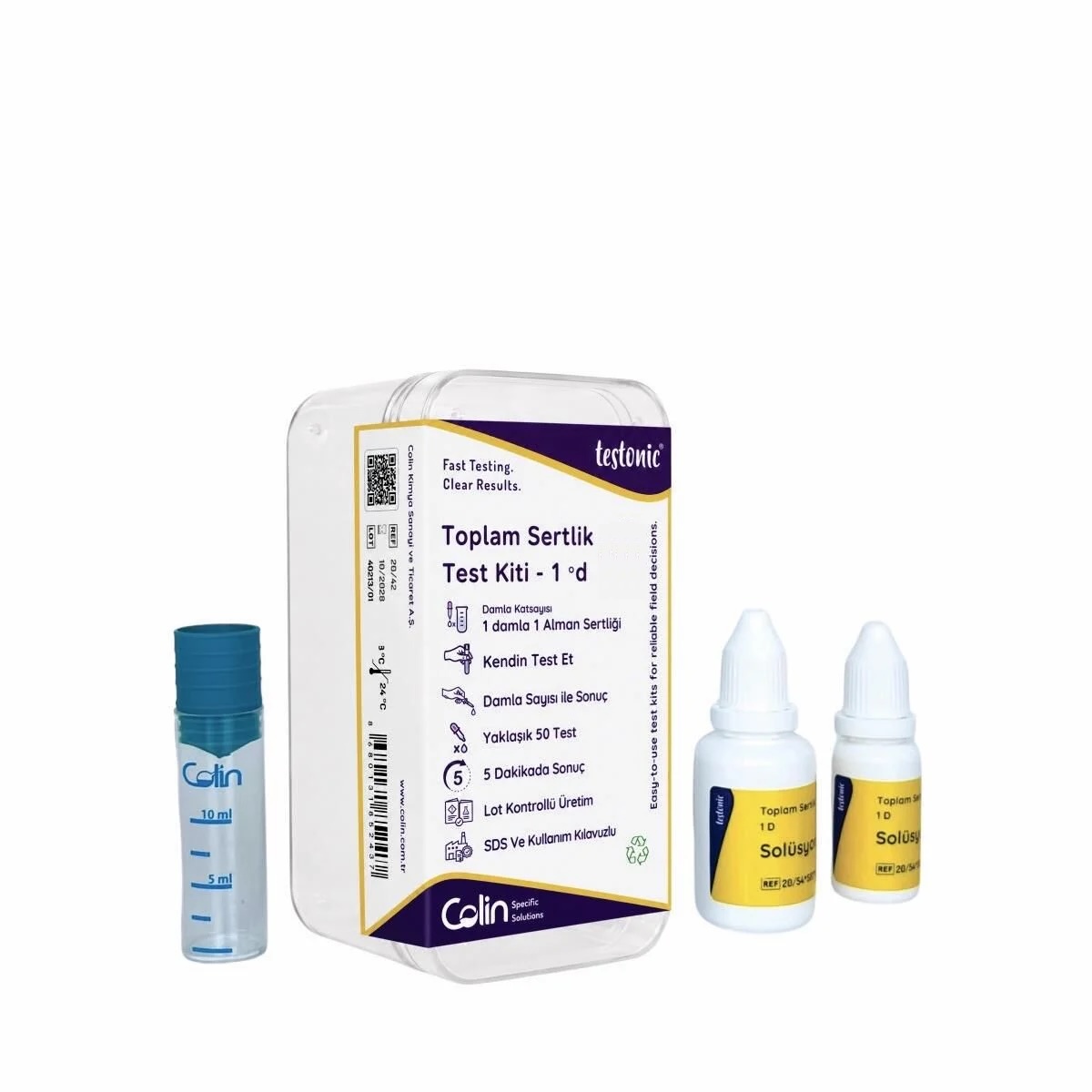
Testonic® Total Hardness Test Kit (1 °dH) is designed for the rapid and practical determination of total water hardness caused by calcium and magnesium ions. It provides numerical hardness results to support scale risk assessment, water treatment monitoring, and routine water quality control.
Suitable for water softening systems, reverse osmosis (RO) pretreatment, steam boilers, cooling towers, textile production, industrial processes, and drinking water applications. Based on a drop-count titration method, the kit eliminates the need for expensive laboratory instruments or complicated analytical procedures. Total hardness is determined by observing the colour-change endpoint, with results available in approximately 5 minutes.
It offers a convenient solution for checking water softener performance, comparing different water sources, and monitoring hardness-related issues in industrial water systems.
Why Is Water Hardness Important?
Dissolved calcium and magnesium ions can contribute to mineral scale formation in pipes, heat exchangers, boilers, and heating systems under suitable temperature and chemical conditions. Scale deposits may restrict water flow, reduce heat transfer efficiency, and increase equipment maintenance requirements. Regular hardness testing helps monitor water softening performance and manage scaling risks.
Testing in 3 Simple Steps
- Prepare the Sample: Fill the clean graduated test tube with the water sample to the level specified in the instruction manual.
- Perform the Test: Add the indicator solution, followed by the titrant solution drop by drop while gently mixing the sample.
- Read the Result: Count the titrant drops until the colour-change endpoint is reached. Each drop corresponds to 1 German degree (1 °dH) of total hardness.
Package Contents
- Total Hardness Indicator Solution
- Total Hardness Titrant Solution (1 °dH)
- 5/10 mL Graduated Measuring Tube
- Instruction Manual
Total water hardness is primarily caused by dissolved calcium (Ca2+) and magnesium (Mg2+) ions. Under suitable temperature and chemical conditions, these minerals can contribute to scale formation in pipelines, heat exchangers, and heat transfer surfaces.
The Testonic® Total Hardness Test Kit (1 °dH) is designed for practical total hardness determination using a drop-count titration method. Each titrant drop corresponds to 1 German degree of hardness (1 °dH). Results are obtained in approximately 5 minutes without laboratory measuring instruments.
Analytical Principle
The measurement is based on drop-count titration with a visual indicator endpoint. The combined hardness contribution of calcium and magnesium ions is determined from the amount of titrant required to reach the endpoint.
When the colour-change endpoint is reached, the number of titrant drops directly indicates total hardness in German degrees (°dH).
The method determines the combined hardness contribution of calcium and magnesium rather than their individual concentrations.
What Is It Used For?
Regular water hardness testing helps monitor changes in water treatment and conditioning processes. It is particularly useful for checking water softening performance and evaluating scaling potential.
Main applications:
- Water softening systems: Comparing inlet and outlet hardness to monitor resin performance and regeneration requirements.
- Reverse osmosis (RO) systems: Checking feedwater hardness and assessing pretreatment performance.
- Steam boilers: Monitoring feedwater hardness and water conditioning programmes.
- Cooling towers: Monitoring circulating water quality and scaling potential.
- Textile dyeing and finishing: Checking hardness in dyeing, washing, and process water.
- Municipal, well, and spring water: Comparing hardness levels from different water sources.
- Aquariums and aquaculture: Monitoring general hardness (GH).
- Industrial cleaning: Evaluating hardness-related effects on detergent consumption and cleaning performance.
How Does the Test Work?
Follow the instruction manual for the exact sample volume, reagent quantities, and endpoint identification.
Technical Specifications
| Measured parameter | Total water hardness |
| Analytical method | Visual colour-endpoint drop titration |
| Drop factor | 1 drop = 1 °dH |
| Nominal reading increment | 1 °dH |
| CaCO3 equivalent | 1 °dH ≈ 17.85 mg/L CaCO3 |
| Analysis time | Approximately 5 minutes |
| Test capacity | Approximately 50 tests |
| Storage conditions | 8–24 °C |
| Package contents | Indicator, 1 °dH titrant solution, graduated measuring tube, and instruction manual |
Calculation of Results
Total hardness is calculated directly from the number of titrant drops used.
Total Hardness (°dH) = Number of Titrant Drops × 1
Example: If the colour-change endpoint is reached after 10 drops, the total hardness is 10 °dH. This corresponds to approximately 178.5 mg/L total hardness expressed as CaCO3.
Common hardness conversions:
- 1 °dH ≈ 17.85 mg/L CaCO3
- 1 °dH ≈ 1.78 °f French hardness
- 1 °f ≈ 0.56 °dH German hardness
Difference Between 1 °dH and 1 °f Test Kits
Both kits measure total water hardness caused by calcium and magnesium ions. The main difference is the measurement unit and drop factor.
- 1 °dH Test Kit: Each drop represents 1 German degree of hardness.
- 1 °f Test Kit: Each drop represents 1 French degree of hardness.
The 1 °dH version allows direct readings in applications where German hardness units are used, including water softening, treatment, and industrial process monitoring. The drop factors of these kits are not interchangeable.
Analytical Interferences and Limitations
- Colour and turbidity: Strongly coloured samples may make endpoint identification difficult.
- Other metal ions: Certain metal ions may interfere depending on analytical conditions.
- Complexing agents: Chemicals that bind calcium and magnesium may affect the measurement.
- pH: Strongly acidic or alkaline samples may influence titration conditions.
- Very low hardness: The nominal 1 °dH reading increment may not provide sufficient differentiation at low hardness levels.
The drop factor represents the nominal reading increment, not a verified statement of analytical accuracy or detection limit.
Important Usage Notes
- Use a clean measuring tube and the specified sample volume.
- Hold the dropper vertically and count drops consistently.
- Mix the sample after each drop.
- Identify the endpoint according to the instructions.
- Higher hardness requires more titrant, so test capacity may vary.
- Store the product within the labelled temperature range of 8–24 °C.
Related and Complementary Tests
- Total Hardness Test Kit (1 °f) – Measurement in French hardness degrees.
- KH Test Kit – Monitoring carbonate-related buffering capacity.
- Calcium Test Kit – Separate determination of calcium concentration.
- RO System Control Kit – Multi-parameter monitoring of water treatment systems.
Frequently Asked Questions
1. How many ppm is 1 German degree of hardness?
One German degree (1 °dH) is approximately equivalent to 17.85 mg/L CaCO3. For example, 10 °dH corresponds to approximately 178.5 mg/L CaCO3.
2. What is the difference between German and French hardness?
Both are water hardness measurement units. One German degree corresponds to approximately 1.78 French degrees. Results can be converted using the appropriate factor.
3. Can I check water softener performance with this kit?
Yes. Comparing hardness before and after the softening unit helps evaluate hardness removal. Applications requiring very low residual hardness may need a method with a smaller reading increment.
4. Are hardness and TDS the same?
No. Hardness primarily represents calcium and magnesium contributions, while TDS refers to total dissolved solids.
5. Are total hardness and KH the same?
No. Total hardness (GH) primarily measures calcium and magnesium hardness. KH commonly refers to carbonate- and bicarbonate-related buffering capacity, especially in aquarium applications.
6. Is hard water safe to drink?
Hardness alone does not determine drinking water safety. Microbiological quality and other chemical parameters must also be considered.
For Drinking Water Production Facilities
It detects lime formation by measuring the hardness of water.
For Textile Finishing and Dyeing Businesses
It ensures proper color retention in dyeing processes by determining water quality.
Test and Process Control Kits for Textile Finishing and Dyeing Mills
Helps monitor calcium-magnesium hardness in process water and dye bath preparation, supporting control of dye uptake, spotting and scale-related risks.
Technical Documents
Related Posts
Related News
Technical Support and Product Consulting
You can use the form to find the most suitable chemical solution for your needs or to obtain detailed information about the technical specifications of our products.
Your requests are carefully reviewed and answered by Colin's expert team.
You can ask us about the product.
