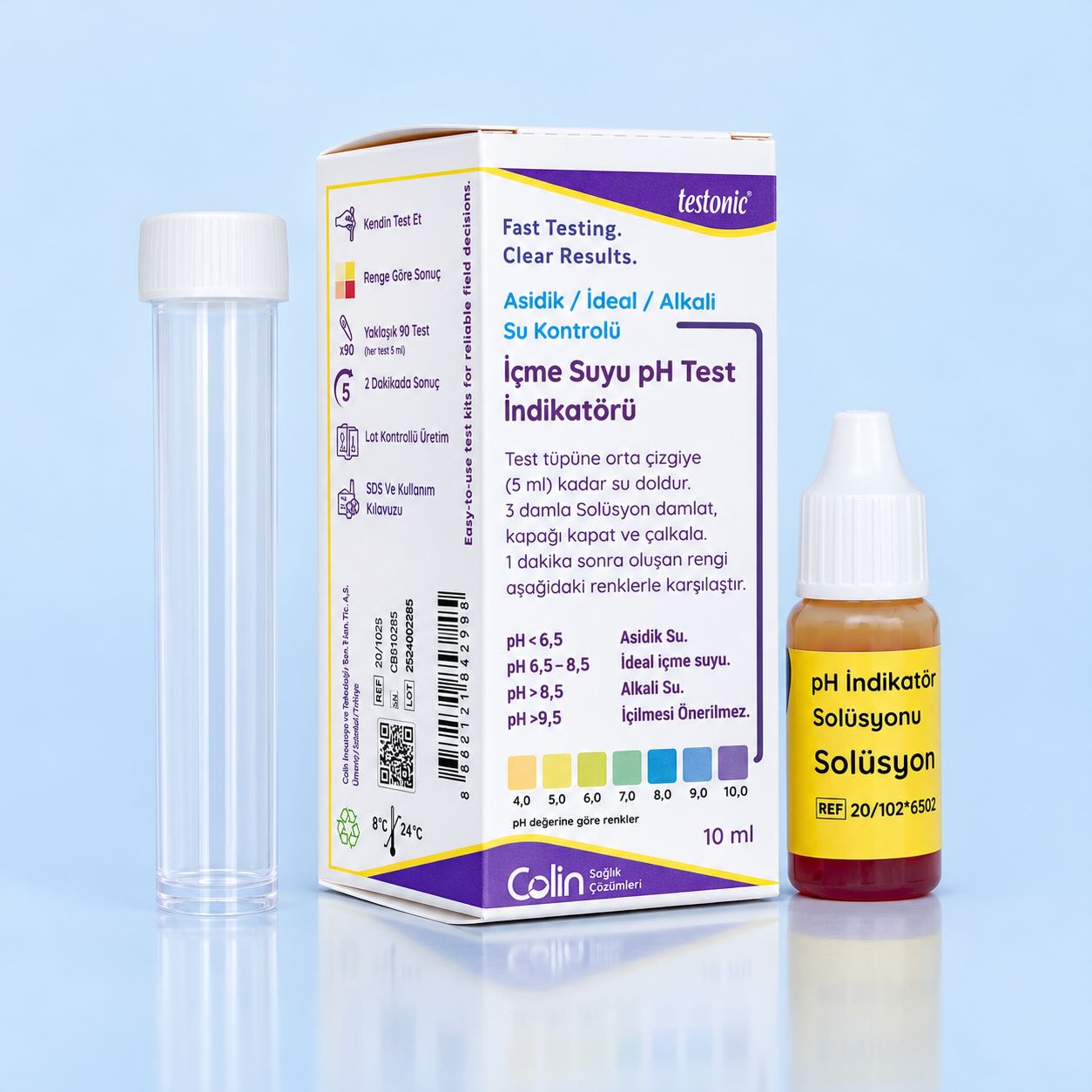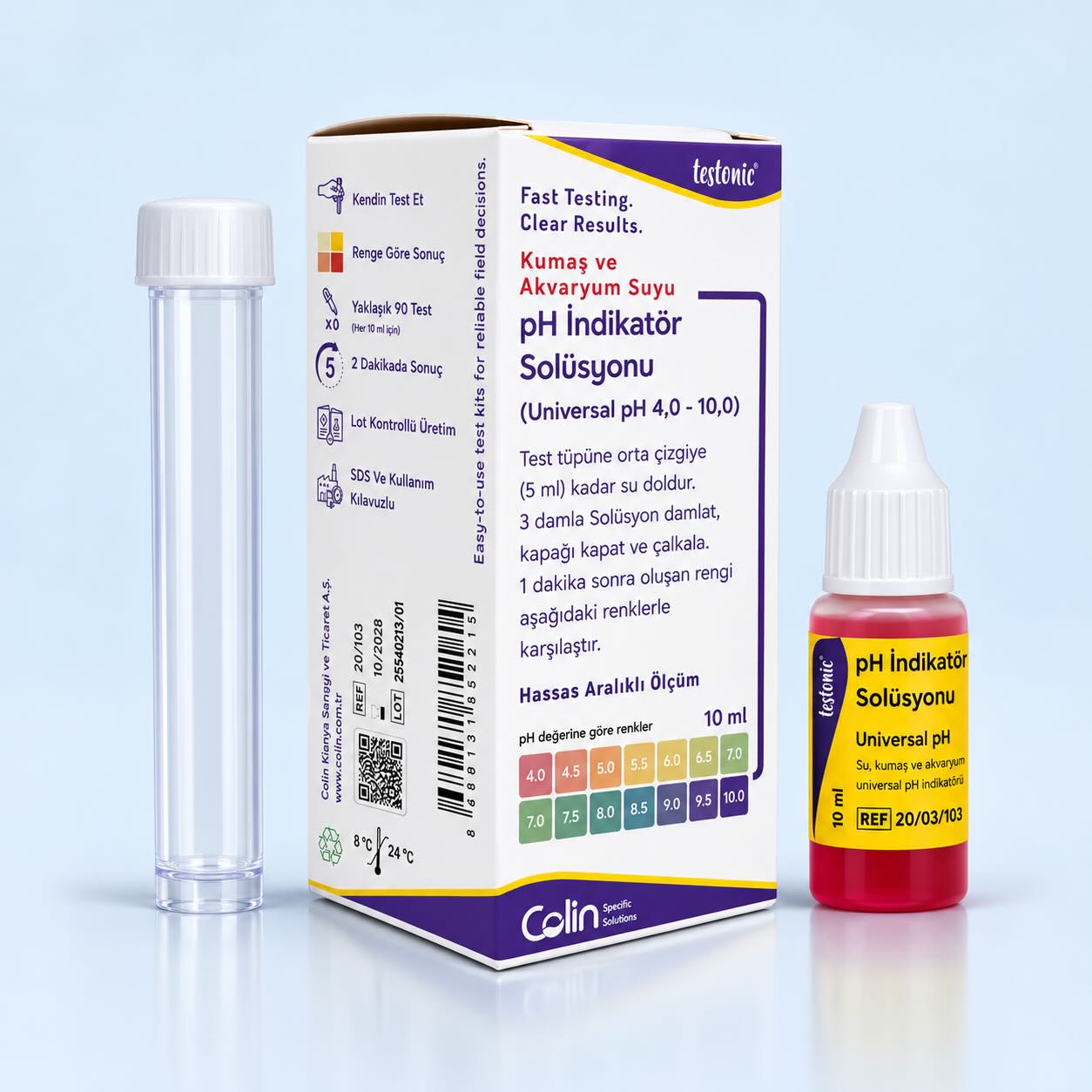
Testonic® Universal pH Indicator Solution (pH 4.0–10.0) is designed for the rapid and convenient determination of pH in water and aqueous samples. It indicates whether a sample is acidic, neutral, or alkaline through a visible color change. The reference color scale, marked in 0.5 pH increments, allows easy pH evaluation.
The solution is particularly suitable for aqueous textile extracts, aquarium water, textile washing and rinsing processes, water treatment systems, and various liquid samples. Its color comparison method eliminates the need for an electronic pH meter or specialized laboratory equipment. Results can be obtained in approximately 2 minutes using only a few drops of indicator.
It provides a practical solution for pH checks after textile processing, monitoring aquarium water, and comparing different water samples. In addition to the 10 mL boxed version, 50 mL, 250 mL, and 1000 mL options are available for regular and higher-volume testing.
Why Is pH Measurement Important?
pH is a fundamental water quality parameter indicating the acidic or alkaline character of water and aqueous solutions. Changes in pH can affect textile washing, dyeing, rinsing, neutralization, and water treatment processes. In aquariums, pH is also important for evaluating the aquatic environment. Regular pH testing helps compare conditions before and after processing and monitor changes in water chemistry.
pH Testing in 3 Simple Steps
- Prepare the Sample: Fill a clean test tube with 5 mL of water or aqueous extract.
- Perform the Test: Add 3 drops of indicator solution. Close the tube, shake gently, and wait for 1 minute.
- Read the Result: Compare the developed color with the supplied pH color scale to determine the approximate pH value.
Available Packaging
- 10 mL: Boxed version, approximately 90 tests.
- 50 mL: Supplied with a color scale and dropper.
- 250 mL: Supplied with a color scale and dropper.
- 1000 mL: Supplied with a color scale and dropper.
Developed with Merck/Supelco 109175 Universal pH Indicator Solution as the reference product.
pH is a fundamental chemical parameter indicating the acidic, neutral, or alkaline character of water and aqueous solutions. Changes in pH can influence textile washing, dyeing, rinsing, neutralization, and water treatment processes. In aquariums, pH is an important characteristic of the aquatic environment. Therefore, pH testing is widely used in textile quality control, aquarium maintenance, water treatment, and industrial processes.
The Testonic® Universal pH Indicator Solution is designed for visual pH determination within the range of 4.0–10.0. Its reference color scale, marked in 0.5 pH increments, allows results to be obtained in approximately 2 minutes without laboratory instruments. It is particularly suitable for testing aqueous textile extracts and aquarium water.
Analytical Principle
A universal pH indicator combines indicator components that produce different colors at different pH values.
When added to an aqueous sample, the indicator develops a color depending on the pH of the solution. The approximate pH value is determined by comparing the developed color with the product's reference scale.
The color scale covers pH 4.0 to 10.0 in 0.5 pH increments:
4.0 – 4.5 – 5.0 – 5.5 – 6.0 – 6.5 – 7.0 – 7.5 – 8.0 – 8.5 – 9.0 – 9.5 – 10.0
In general, acidic samples produce reddish and yellow tones, near-neutral samples appear green, and alkaline samples develop blue or purple tones.
The method provides a convenient way to perform routine pH checks without an electronic pH meter.
What Is It Used For?
pH measurement helps evaluate the acidic or alkaline character of a liquid. Monitoring pH changes in production and water preparation processes supports better control of operating conditions.
In textile processing, pH testing of aqueous extracts is particularly useful for evaluating washing and neutralization processes. In aquariums, regular pH monitoring helps track changes in water conditions.
Main applications:
- Aqueous textile extracts: Evaluating acidic or alkaline characteristics of fabrics after processing.
- Textile dyeing and finishing: Monitoring pH changes during washing, rinsing, and neutralization.
- Aquariums: Checking the pH of water containing fish, aquatic plants, and other organisms.
- Drinking and domestic water: Comparing pH values of different water sources.
- Water treatment systems: Monitoring pH before and after treatment.
- Industrial washing: Checking pH during cleaning and rinsing processes.
- Chemical processes: Convenient evaluation of acidic and alkaline conditions in aqueous solutions.
How Is the Test Performed?
pH testing with the universal indicator is performed in three simple steps.
The entire procedure, including sample preparation and color comparison, can be completed in approximately 2 minutes.
Technical Specifications
| Measured parameter | pH |
| Analytical method | Colorimetric comparison using a universal indicator |
| Measurement range | pH 4.0–10.0 |
| Color scale increment | 0.5 pH |
| Sample volume | 5 mL |
| Indicator dosage | 3 drops per 5 mL sample |
| Color development time | Approximately 1 minute |
| Total test time | Approximately 2 minutes |
| Test capacity | Approximately 90 tests per 10 mL |
| Instrument requirement | No electronic pH meter required |
| Storage conditions | 8–24 °C, container tightly closed |
| Available sizes | 10 mL, 50 mL, 250 mL, and 1000 mL |
Packaging Options and Test Capacity
The solution is offered in four packaging sizes to meet the needs of individual users, laboratories, and facilities performing regular pH measurements.
| Size | Packaging | Application |
|---|---|---|
| 10 mL | Boxed package | Approximately 90 tests; individual and routine use |
| 50 mL | With additional color scale and dropper | Regular pH testing |
| 250 mL | With additional color scale and dropper | Laboratory and commercial use |
| 1000 mL | With additional color scale and dropper | High-volume and frequent testing applications |
Result Interpretation
pH is a logarithmic scale describing the acidic or alkaline character of a solution. At approximately 25 °C, pH 7 is considered neutral.
Results can be interpreted using the reference color scale:
- pH 4.0–6.5: Acidic range
- pH 7.0: Neutral range
- pH 7.5–10.0: Alkaline range
Example: A sample matching the pH 5.5 reference is acidic, a sample matching pH 7.0 is neutral, and a sample matching pH 9.0 is alkaline.
The 0.5 pH increments indicate the spacing between reference colors. The approximate pH result is determined by selecting the closest matching color.
pH Testing of Aqueous Textile Extracts
Textile manufacturing involves dyeing, bleaching, washing, neutralization, and finishing operations. Chemicals used during these processes may influence the pH of aqueous extracts prepared from fabrics.
Measuring extract pH helps evaluate the acidic or alkaline characteristics of textiles after processing. pH testing after washing and neutralization is particularly useful for monitoring processing conditions.
ISO 3071 is an internationally used method for determining the pH of aqueous textile extracts. A universal pH indicator can provide a rapid visual preliminary check. Where formal standard compliance reporting is required, the procedure specified in the applicable standard should be followed.
Aquarium Water pH Monitoring
Aquarium water pH is an important characteristic of the environment in which fish, aquatic plants, and other organisms live.
Different species may prefer different pH conditions. Regular testing helps monitor changes following water replacement or changes in aquarium operating conditions.
Considering pH together with carbonate hardness (KH) and general hardness (GH) provides a broader understanding of aquarium water chemistry.
Which Other Water Parameters Can Be Tested?
pH measurement is a useful starting point for evaluating water quality. Depending on the application, hardness, alkalinity, and metal concentrations may also be monitored.
| Parameter | Related Test | Monitoring Purpose |
|---|---|---|
| pH | Universal pH Indicator Solution | Determining acidic, neutral, or alkaline conditions |
| Carbonate Hardness / Alkalinity | KH Test Kit | Evaluating water buffering capacity |
| Total Hardness | Total Hardness Test Kit | Determining calcium and magnesium hardness |
| Bicarbonate | Bicarbonate Test Kit | Determining bicarbonate concentration |
| Iron | Iron Test Kit | Monitoring iron concentration |
Important Application Notes
- Use a clean test tube and a 5 mL sample.
- Add 3 drops of indicator for the standard procedure.
- Shake gently and allow approximately 1 minute for color development.
- Compare colors under adequate, consistent lighting.
- For textile applications, prepare an aqueous fabric extract before testing.
- Keep the indicator bottle closed after use.
Frequently Asked Questions
1. What is a universal pH indicator?
It is an indicator system that produces different colors at different pH values to show whether a sample is acidic, neutral, or alkaline. This product covers pH 4.0–10.0.
2. Can it be used to test textile pH?
Yes. It can be used to check the approximate pH of aqueous extracts prepared from fabrics. It is particularly useful for preliminary checks after washing and neutralization.
3. Can it replace ISO 3071 testing?
The universal indicator provides a rapid visual preliminary check of textile extract pH. Formal ISO 3071 compliance measurements should follow the procedure specified in the standard.
4. Can it be used for aquarium water?
Yes. It can be used to check aquarium water pH and monitor changes following water replacement or adjustments to aquarium conditions.
5. Are pH and alkalinity the same?
No. pH describes the current acidic or alkaline character of a solution. Alkalinity is related to its capacity to neutralize added acid.
6. What do 0.5 pH increments mean?
The reference color scale includes separate values such as pH 4.0, 4.5, and 5.0, allowing a more detailed visual comparison of approximate pH.
7. How many tests can be performed with one bottle?
A 10 mL bottle provides approximately 90 tests. The standard procedure uses 3 drops of indicator for a 5 mL sample. Larger sizes are available for regular and high-volume testing.
8. Are the larger bottles supplied with a color scale and dropper?
Yes. The 50 mL, 250 mL, and 1000 mL options include a color scale and dropper. The 10 mL version is supplied in a boxed package.
For Drinking Water Production Facilities
Used to quickly measure the pH level of drinking water.
For Textile Finishing and Dyeing Businesses
Provides pH control by measuring the pH value of the fibers.
Pollution Monitoring and Water Quality Testing for Environmental and Wastewater Management
Determining pH levels in water and wastewater samples provides critical analysis for monitoring environmental pollution and water treatment processes.
Test and Process Control Kits for Textile Finishing and Dyeing Mills
Provides rapid pH control in fabric, process-water and bath samples, supporting on-site monitoring of neutralization, acidification, washing and dyeing steps.
Testonic® Dyehouse Control Pack
Provides rapid pH control for fabric, process water and rinsing baths. Supports practical on-site decisions before dyeing, after dyeing and during neutralization steps.
Technical Documents
Related Posts
Related News
Technical Support and Product Consulting
You can use the form to find the most suitable chemical solution for your needs or to obtain detailed information about the technical specifications of our products.
Your requests are carefully reviewed and answered by Colin's expert team.
You can ask us about the product.