


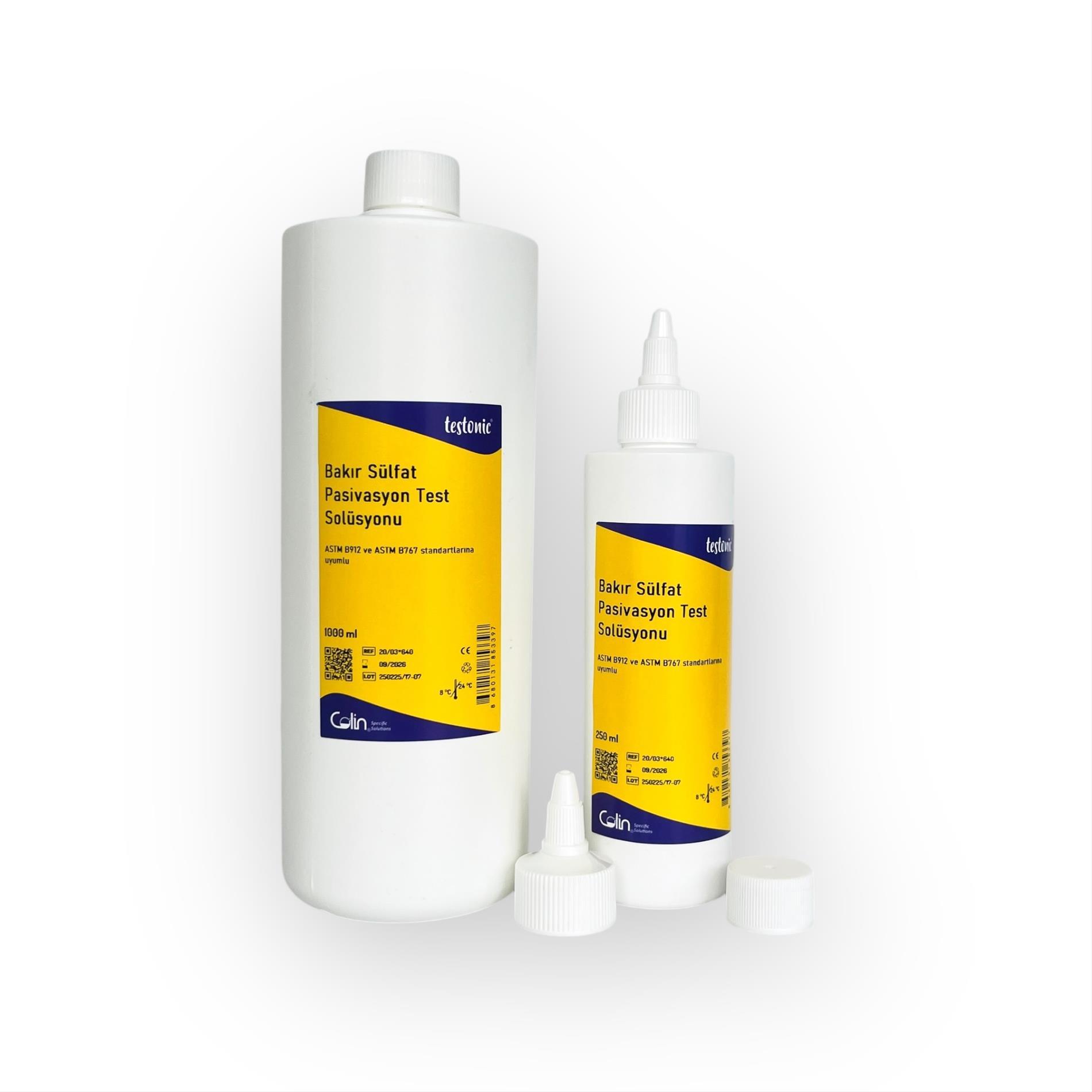
Testonic PassiCopper™ is a copper sulfate-based direct surface test designed to help rapidly detect reactive free iron remaining on stainless steel surfaces after cleaning, pickling, and passivation processes.
During fabrication, welding, grinding, mechanical processing, maintenance, or contact with carbon steel tools and particles, foreign iron may be transferred onto stainless steel surfaces. Such iron contamination can later contribute to local surface reactions, rust staining, and the early development of corrosion-related defects.
PassiCopper™ is applied directly to the stainless steel surface and helps identify areas containing reactive free iron through a visible surface reaction. This makes it a practical solution for post-passivation quality control, final surface verification, and field inspection.
Does reactive free iron remain on the stainless steel surface after passivation or surface treatment?
Why Use PassiCopper™?
Using the correct stainless steel grade does not automatically mean that the surface is in the desired condition. Carbon steel tools, grinding equipment, welding operations, metal particles, or fabrication contact can introduce free iron contamination onto the stainless steel surface.
For this reason, checking the surface after passivation helps identify reactive iron contamination before the equipment enters service. This can support better surface quality control during manufacturing, final inspection, and commissioning.
The test can be applied directly to the stainless steel surface without separate sample preparation.
Helps visually identify areas where reactive free iron is present.
Adds a practical surface verification step after passivation or surface treatment.
Provides rapid control on tanks, pipes, fabricated equipment, and stainless steel components.
Why Should Free Iron Be Checked?
The corrosion resistance of stainless steel is associated with the chromium-rich passive layer formed on its surface. However, foreign iron particles transferred during manufacturing or maintenance can behave differently from the stainless steel substrate.
Under humid or process conditions, these particles may oxidize and cause rust staining, localized discoloration, or early corrosion-related surface defects. This is particularly important in process equipment where a clean and controlled stainless steel surface is required.
For this reason, PassiCopper™ is not only a final inspection tool; it can also be incorporated into the quality assurance process for stainless steel surface treatment and passivation.
Main Applications
- Stainless steel tanks and reactors
- Stainless steel piping and pipelines
- Food and beverage processing equipment
- Pharmaceutical production equipment
- Chemical and process plants
- CIP systems and process lines
- Post-weld cleaned stainless steel surfaces
- Pickled and passivated equipment
- Ground and mechanically processed stainless steel surfaces
- Newly fabricated stainless steel equipment
- Surface control after maintenance and repair
- Pre-commissioning quality control
Product Features
| Control Purpose | Detection of reactive free iron on stainless steel surfaces |
| Test Surface | Stainless steel surface |
| Test Type | Copper sulfate-based direct surface reaction |
| Result | Visible surface reaction |
| Main Use | Free iron control after passivation, surface cleaning, and fabrication |
| Evaluation | Visual |
| Instrument Requirement | No instrument required |
Advantages of Post-Passivation Surface Control
Passivation is an important production step for establishing a clean and corrosion-resistant stainless steel surface. However, especially on large tanks, welded structures, or complex piping systems, it may be useful to verify that critical areas have achieved the expected surface condition.
Because PassiCopper™ is applied directly to the surface, critical areas can be checked rapidly in production or field conditions. This makes post-passivation surface verification more practical for manufacturers, quality control teams, and end users.
Who Is It Suitable For?
- Stainless steel tank and equipment manufacturers
- Stainless steel piping companies
- Food processing equipment manufacturers
- Pharmaceutical equipment manufacturers
- Chemical and process equipment manufacturers
- Welding and stainless steel fabrication companies
- Pickling and passivation service providers
- Quality control departments
- Maintenance and technical service teams
- Commissioning and field inspection teams
Testonic™ Surface Treatment Verification Product Group
Different questions in stainless steel surface quality control may require different sample types and test approaches. For this reason, PassiCopper™, PassiFerro™, and Ferro-Check™ form a complementary group of products for surface treatment verification.
| Product | Control Method | Main Control Question |
|---|---|---|
| PassiCopper™ | Direct stainless steel surface | Does reactive free iron remain on the surface? |
| PassiFerro™ | Extract obtained from the metal surface | Is extractable iron residue present on the surface? |
| Ferro-Check™ | Localized direct surface control | Is there active iron or a localized corrosion-related area at a weld, joint, or suspicious location? |
For general direct post-passivation surface control, use PassiCopper™; for evaluation of iron extracted from a defined surface area, use PassiFerro™; and for localized inspection of welds, joints, and suspicious areas, use Ferro-Check™.
What Does Using the Products Together Provide?
For stainless steel tanks, process equipment, or piping systems, a single surface-control approach may not answer every quality-control question.
PassiCopper™ provides rapid direct surface control, PassiFerro™ evaluates iron extracted from a defined surface area, and Ferro-Check™ supports localized inspection of welds and other critical areas.
For companies that perform passivation in-house, manufacture stainless steel equipment, or provide customers with post-passivation quality verification, using these three products together can provide a more comprehensive surface control approach.
Colin Quality and Technical Support
Testonic PassiCopper™ is manufactured by Colin Kimya to provide rapid and practical free iron control on stainless steel surfaces after fabrication and passivation.
Depending on the surface quality-control requirement, PassiCopper™, PassiFerro™, and Ferro-Check™ may be used individually or as complementary tools within the same inspection system. Colin's technical team can provide support for selecting the most appropriate product for the application.
Technical Documents
Technical Support and Product Consulting
You can use the form to find the most suitable chemical solution for your needs or to obtain detailed information about the technical specifications of our products.
Your requests are carefully reviewed and answered by Colin's expert team.
You can ask us about the product.
