


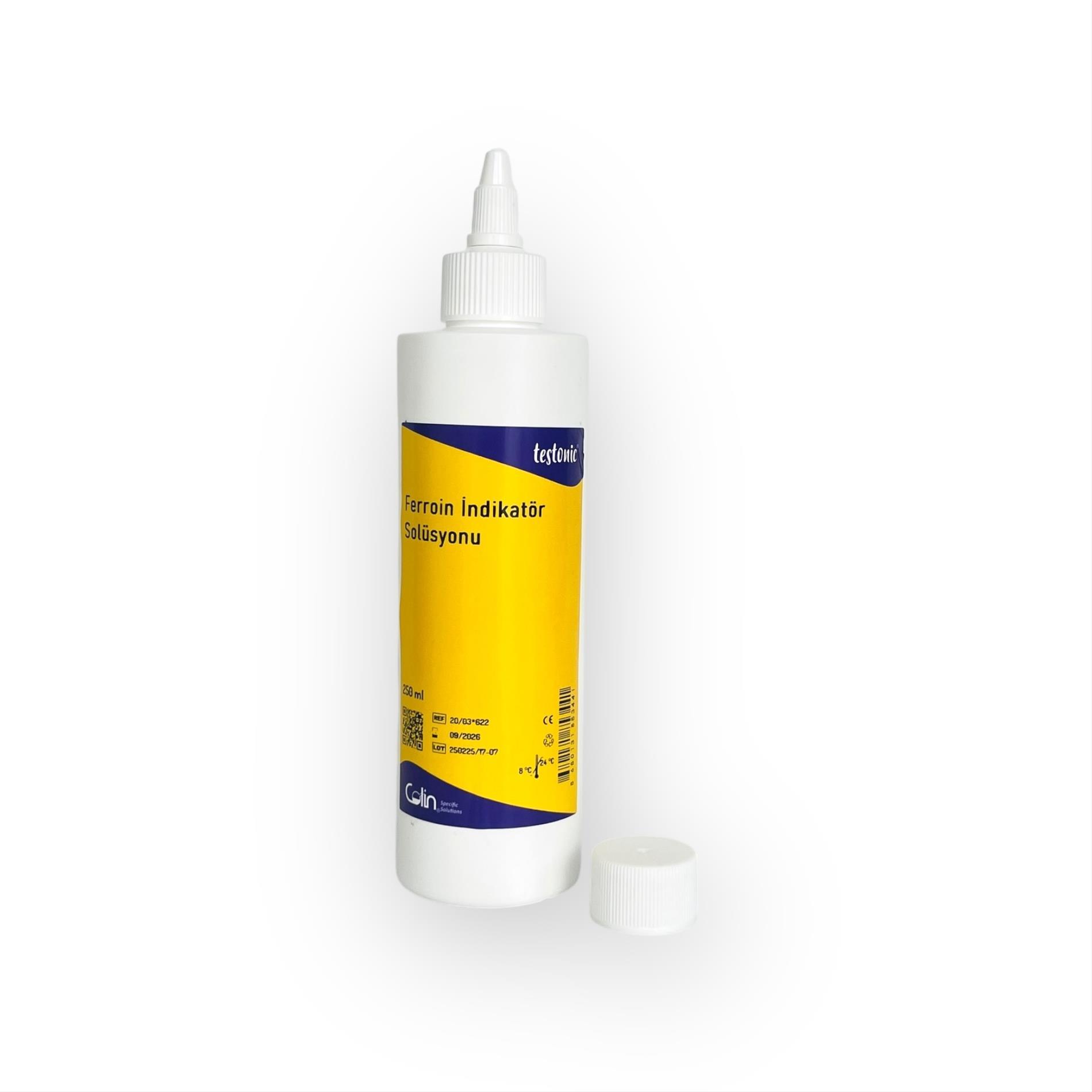
Testonic Ferroin Indicator Solution – 0.025 M is a ready-to-use laboratory indicator designed for clear and reproducible endpoint detection in redox titrations.
Based on the tris(1,10-phenanthroline)iron(II) complex, ferroin is particularly suitable for Chemical Oxygen Demand (COD) analysis, dichromate–iron(II) titrations and other redox methods in which the ferroin transition range is appropriate. Its standardised concentration supports consistent endpoint interpretation across different analyses and operators.
What Is Ferroin Indicator Used For?
Accurate endpoint determination is one of the most important stages affecting the reliability of a redox titration. In strongly oxidising or reducing systems, even a small excess of titrant beyond the endpoint can influence the calculated result.
Ferroin is a redox indicator that exhibits a distinct colour change according to its oxidation state. In suitable titration systems, this behaviour makes the region close to the equivalence point easier to observe visually.
Testonic 0.025 M Ferroin Indicator Solution eliminates the need for routine preparation before each analytical series and supports speed, standardisation and reproducibility in laboratory work.
Chemical and Technical Properties
| Property | Specification |
|---|---|
| Product Type | Redox indicator solution |
| Active Complex | Tris(1,10-phenanthroline)iron(II), [Fe(phen)3]2+ |
| Nominal Concentration | 0.025 mol/L |
| Function | Visual endpoint indicator for redox titrations |
| Main Application | COD and other suitable redox titration methods |
Why Is Ferroin Used in COD Analysis?
In classical dichromate-based COD analysis, oxidisable substances in the sample react with a known amount of dichromate. After digestion, the remaining oxidant is determined by back-titration with a standard iron(II) solution.
Ferroin provides a distinct colour transition at the endpoint and helps the analyst determine titrant consumption more consistently.
For this reason, ferroin is widely used as an auxiliary reagent in classical dichromate COD determinations for water, wastewater, process-water and environmental samples.
Which Analyses Can It Be Used For?
Why Use Ready-to-Use 0.025 M Ferroin?
For a redox indicator, selecting the correct chemistry is important, but so is using a consistent concentration and amount in each analysis. Indicator solutions prepared separately by different analysts may introduce variation through weighing, dilution and preparation differences.
A ready-to-use 0.025 M ferroin solution provides the same nominal indicator concentration for routine analysis, helping to reduce preparation-related variability and simplify laboratory procedure standardisation.
This is particularly valuable in environmental, water, wastewater and industrial quality-control laboratories performing large numbers of routine COD analyses.
Why Is Correct Endpoint Interpretation Important?
Titrimetric calculations depend directly on the volume of titrant consumed. Detecting the endpoint too late or adding excess titrant therefore directly affects the calculated analytical result.
In analytical systems where ferroin is suitable, its distinct colour transition helps the analyst stop the titration more consistently. Applying the same endpoint criterion is especially important when comparing results from routine or serial analyses.
What Should Be Checked When COD Results Are Inconsistent?
| Observed Problem | Possible Cause | What Should Be Checked |
|---|---|---|
| Endpoint is difficult to distinguish | Indicator amount, indicator condition or sample colour may affect visual interpretation. | Indicator dosage, reagent condition and the endpoint criterion specified by the method. |
| Blank values are variable | Titrant normality, reagent quality or procedure conditions may be changing between batches. | FAS standardisation, dichromate solution, indicator dosage and blank procedure. |
| Replicate analyses differ | Differences in endpoint interpretation or titrant standardisation may be involved. | Use the same indicator dosage, endpoint criterion and titration technique. |
| COD result is unexpectedly high or low | The cause may not be the indicator alone; digestion conditions, blank correction, titrant normality or interferences may be responsible. | Evaluate the entire COD procedure, blank, control sample and titrant standardisation together. |
Which Laboratories Use Ferroin Indicator?
What Should Be Considered When Selecting Ferroin Indicator?
A redox indicator should not be selected solely because it produces a visible colour change. Its transition potential must be suitable for the redox reaction being titrated.
Ferroin should therefore be used in analytical methods that specify ferroin or where the redox conditions are compatible with its transition range. It should not automatically be considered a universal indicator for every oxidising or reducing titration.
For standard-method analysis, the indicator type, amount, titrant concentration and endpoint criterion should be applied according to the relevant analytical procedure.
Frequently Asked Questions
Recommended Test Kits and Solutions for Universities and Educational Institutions
It is one of the basic indicators used to teach redox titrations to students in laboratory training in chemistry and engineering departments.
Test and Process Control Kits for Textile Finishing and Dyeing Mills
Used as an indicator in oxidation-reduction titrations, supporting peroxide, active oxygen or special process-control analyses.
Technical Documents
Related Posts
Related News
Technical Support and Product Consulting
You can use the form to find the most suitable chemical solution for your needs or to obtain detailed information about the technical specifications of our products.
Your requests are carefully reviewed and answered by Colin's expert team.
You can ask us about the product.
