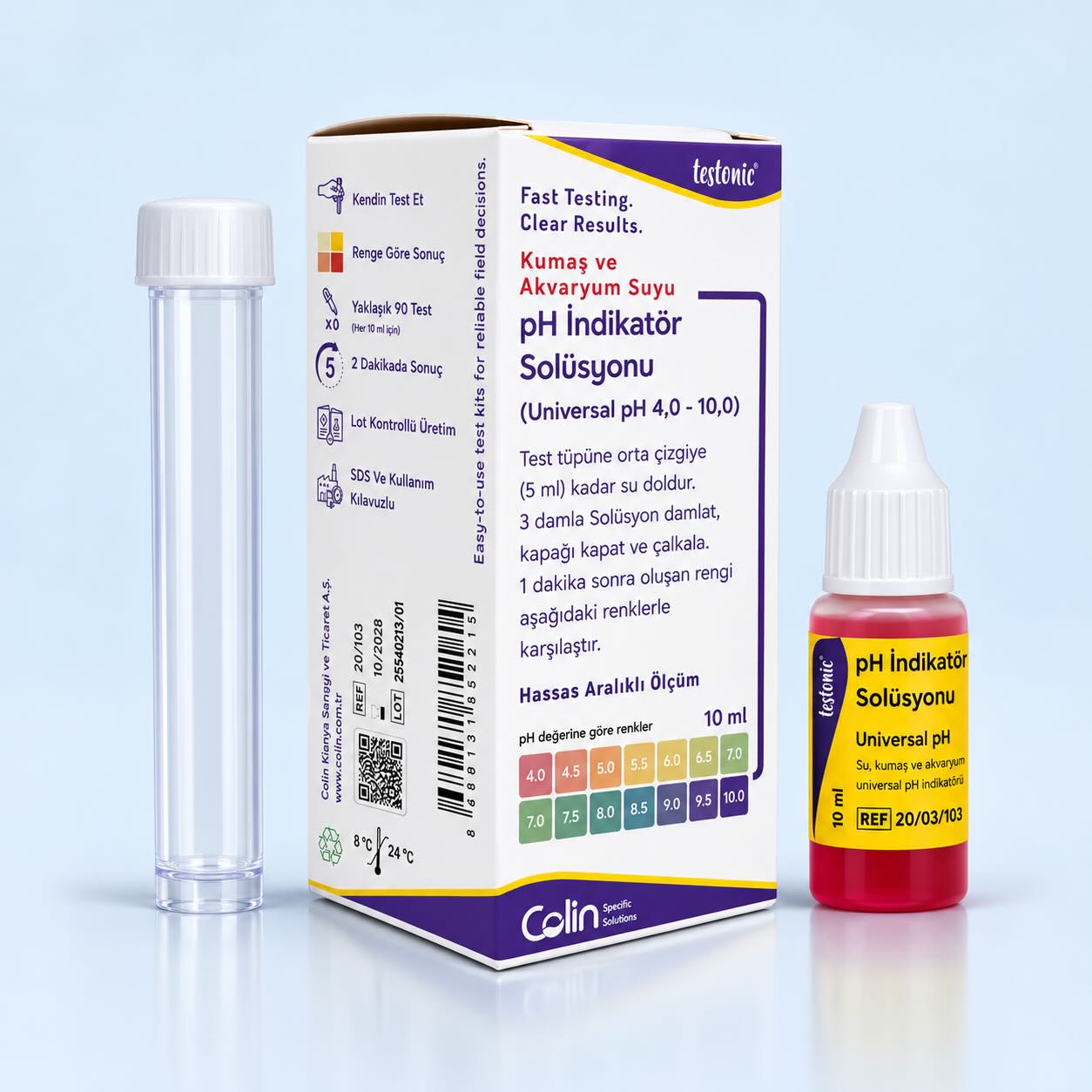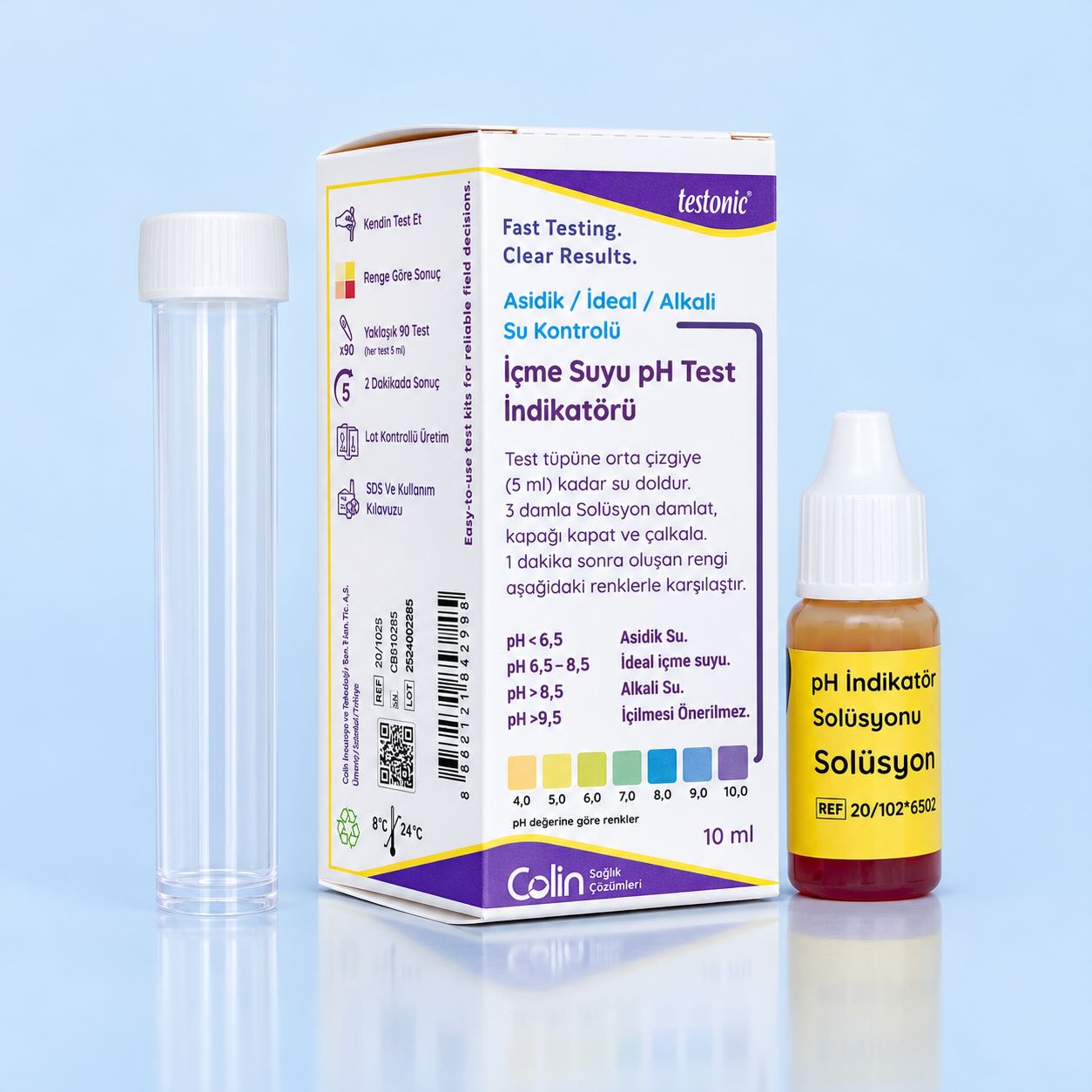
Testonic® Drinking Water pH Test Indicator is designed for quick and convenient pH checks of drinking, tap, and purified water. It uses color changes to indicate whether water is acidic, neutral, or alkaline, helping users monitor water quality and compare different water sources.
Ideal for everyday checks of household water, water purifiers, reverse osmosis (RO) systems, bottled water, and well water. Its color-comparison method eliminates the need for an electronic pH meter or laboratory equipment. Simply add a few drops of indicator to the sample and compare the resulting color with the supplied pH chart.
It offers a practical way to observe pH changes before and after water treatment, compare drinking water sources, and perform routine water checks at home.
Why Is Drinking Water pH Important?
pH is a fundamental water-quality parameter that describes whether water is acidic or alkaline. It can influence taste, mineral solubility, interactions with plumbing materials, and water-treatment processes. Routine pH testing helps users observe changes in purified water and compare different drinking water sources.
Test Water pH in 3 Simple Steps
- Prepare the Sample: Fill the test tube with water to the 5 mL mark.
- Perform the Test: Add 3 drops of pH indicator. Close the tube and shake gently.
- Read the Result: Wait 1 minute and compare the developed color with the pH 4–10 reference chart on the package.
How to Interpret pH Results
- Below pH 7: Acidic water.
- pH 7: Neutral water.
- Above pH 7: Alkaline water.
- pH 6.5–8.5: A commonly preferred operational range for drinking water.
pH is only one aspect of water quality and does not, by itself, establish whether water is safe to drink.
Package Contents
- 10 mL pH indicator solution
- Graduated test tube with cap
- pH 4.0–10.0 color chart
- Instructions for use
Testonic® Drinking Water pH Test Indicator is designed to determine the pH of drinking, tap, well, and purified water by visual color comparison. It allows users to identify whether a water sample is acidic, neutral, or alkaline.
The test uses a seven-step reference chart covering pH 4.0–10.0. Requiring no electronic instrument, it provides a practical solution for household water checks and pH comparisons before and after water treatment.
pH 4.0–10.0
7-step color chart
Approx. 2 minutes
Approx. 90 tests
Analytical Principle
pH is a logarithmic measure of hydrogen ion activity in a solution. It is a fundamental analytical parameter used to describe the acidic or basic character of water.
The test is based on the pH-dependent color changes of acid-base indicators. When the indicator is added to a water sample, its color changes according to the pH of the solution. The resulting color is compared with the reference chart to obtain an approximate pH value.
Unlike a calibrated electronic pH meter, this is a visual, semi-quantitative method. The chart includes reference colors for pH 4, 5, 6, 7, 8, 9, and 10.
Applications
- Drinking and tap water: Identifying the acidic, neutral, or alkaline character of everyday water.
- Reverse osmosis (RO) systems: Comparing pH before and after treatment.
- Bottled water: Comparing pH values from different water sources.
- Well water: Monitoring changes in water pH over time.
- Remineralization filters: Observing the effect of mineral addition on pH.
How to Perform the Test
Fill the clean test tube with 5 mL of the water sample, up to the middle mark.
Add 3 drops of pH indicator. Close the tube and shake gently to mix.
Wait 1 minute. Compare the developed color with the pH 4.0–10.0 reference chart on the package.
Technical Specifications
| Parameter | pH |
| Analytical Method | Colorimetric, visual color comparison |
| Measuring Range | pH 4.0–10.0 |
| Reference Values | pH 4, 5, 6, 7, 8, 9, and 10 |
| Sample Volume | 5 mL |
| Indicator Dose | 3 drops |
| Color Development Time | Approx. 1 minute |
| Total Test Time | Approx. 2 minutes |
| Indicator Volume | 10 mL |
| Test Capacity | Approx. 90 tests |
| Storage Temperature | 8–24 °C |
Interpretation of Results
The pH value is determined by matching the developed sample color to the closest reference color on the package.
| pH 4–6 | Acidic range; yellow and yellowish colors |
| pH 7 | Neutral range; green color |
| pH 8–10 | Alkaline range; blue and purple colors |
pH 6.5–8.5 is a commonly used operational and acceptability reference range for drinking water systems. However, the appropriate pH depends on water composition, treatment conditions, and plumbing materials.
A pH measurement alone cannot establish drinking-water safety. For example, water with pH 7 may still contain undesirable contaminants, while a pH above 8.5 does not automatically indicate a health hazard or make the water unsuitable for consumption.
Because the reference chart has whole-number pH steps, intermediate values such as pH 6.5 or 8.5 can only be estimated visually. A calibrated electronic pH meter is preferable when precise numerical readings are required.
Why Can Purified Water pH Change?
Reverse osmosis systems remove a substantial portion of dissolved ions from water. Purified water with low mineral content and low alkalinity may show changes in pH when exposed to carbon dioxide in the air.
Systems equipped with remineralization or pH-adjustment filters may produce water with a different pH. Comparing samples before and after treatment helps users observe the effect of the purification system on water pH.
Related Water Analyses
| pH | Acidic or alkaline character of water |
| Total Hardness | Hardness associated with calcium and magnesium |
| Alkalinity | Acid-neutralizing capacity of water |
| Free Chlorine | Monitoring disinfectant residual in chlorinated water |
Important Notes
- Use a clean test tube and rinse it appropriately before each measurement.
- Use 5 mL of sample and 3 drops of indicator.
- Compare the color after the specified waiting period and under adequate lighting.
- Strongly colored or cloudy samples may make visual interpretation difficult.
- The indicator is intended for testing only; do not drink the tested sample.
- The kit does not replace comprehensive laboratory water-quality analysis.
Frequently Asked Questions
A pH range of 6.5–8.5 is commonly used as an operational reference. The most suitable value depends on water composition and treatment conditions.
At ordinary ambient temperatures, pH 7 indicates neutral water. However, it does not by itself confirm that water is safe to drink.
Yes. Water with a pH above 7 is alkaline. This does not necessarily make it healthier than water with a lower pH.
Reverse osmosis can reduce the mineral content and buffering capacity of water. Dissolved carbon dioxide may also influence its pH.
Yellow tones indicate lower pH values, green represents the approximately neutral range, and blue-to-purple tones indicate alkaline values. Always compare the sample with the package chart.
The chart uses whole-number reference steps. Intermediate values can be estimated visually; use a calibrated pH meter when precise decimal readings are needed.
No. pH indicates the acidic or alkaline character of water, while total hardness is mainly associated with calcium and magnesium ions.
Approximately 90 tests can be performed using the 10 mL indicator bottle at 3 drops per test.
For Drinking Water Production Facilities
Provides precise pH measurement in water analysis.
Recommended Test Kits and Solutions for Universities and Educational Institutions
It is suitable for analyzing the pH level of solutions used in academic studies.
Test and Process Control Kits for Textile Finishing and Dyeing Mills
Provides rapid pH control in fabric, process-water and bath samples, supporting on-site monitoring of neutralization, acidification, washing and dyeing steps.
Technical Documents
Related Posts
Related News
Technical Support and Product Consulting
You can use the form to find the most suitable chemical solution for your needs or to obtain detailed information about the technical specifications of our products.
Your requests are carefully reviewed and answered by Colin's expert team.
You can ask us about the product.