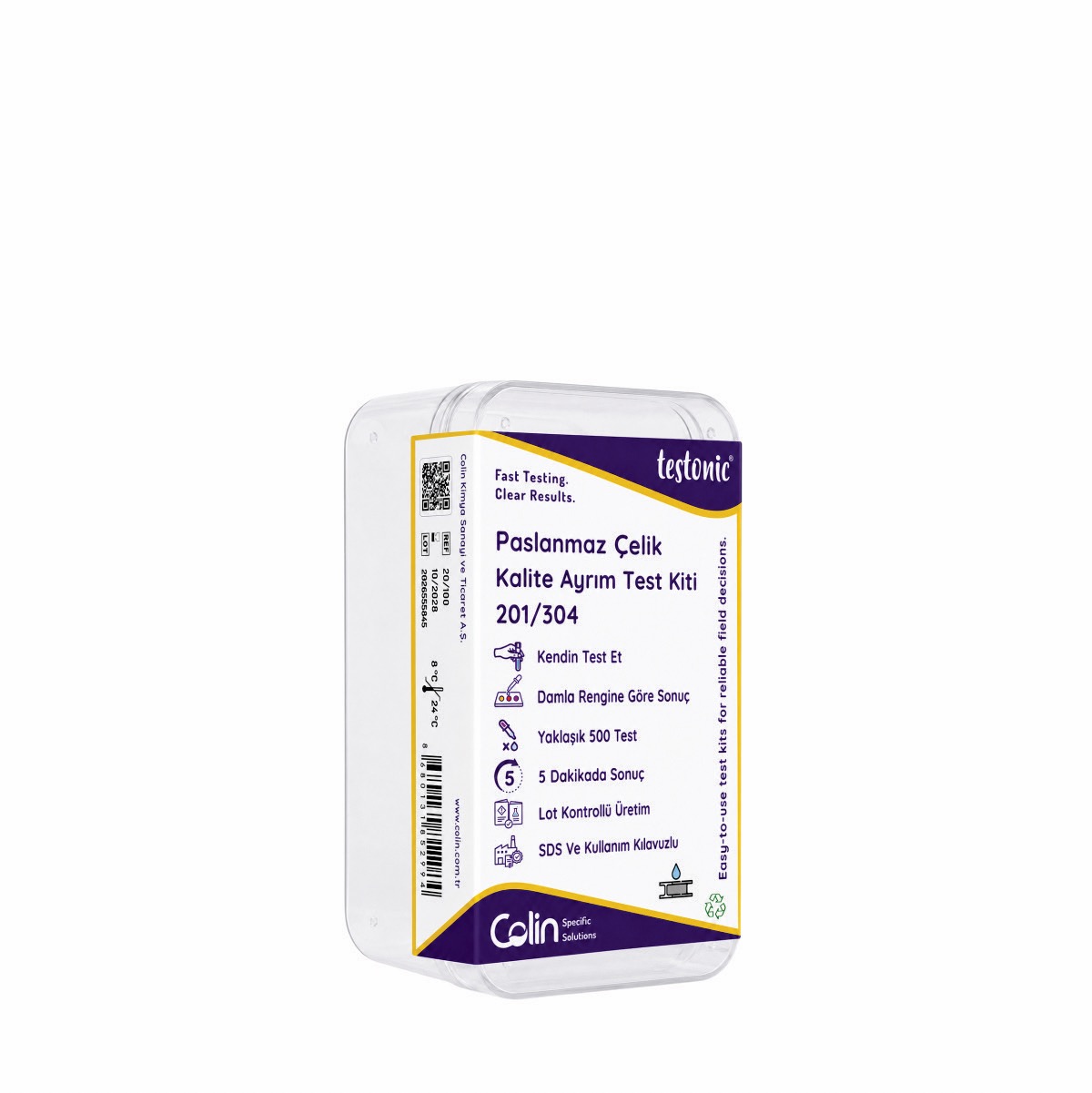


Testonic™ Stainless Steel Grade Identification Test Kit – 304/316 is a professional field test system developed to help rapidly and reliably differentiate 304 and 316 grade stainless steel in stainless steel sheets, pipes, profiles, fittings, components, and equipment.
304 and 316 grade stainless steels are extremely similar in appearance. However, one of the key distinguishing characteristics of 316 stainless steel is the presence of molybdenum. The Testonic™ 304/316 system helps make this alloy difference clearly evaluable under field conditions.
A key feature of the kit is the AlloyCheck Probe Electrochemical Test Instrument. The AlloyCheck Probe applies a controlled electrical current to the test point, providing localized electrochemical activation of the stainless steel surface. This controlled activation helps produce a stronger and more repeatable test reaction, supporting reliable differentiation between 304 and 316 grades.
Is the stainless steel material 304 grade or 316 grade?
Why Is 304/316 Grade Differentiation Important?
Although 304 and 316 stainless steels may look very similar in many industrial applications, their alloy compositions and service performance are not identical. One of the important differences is the presence of molybdenum in 316 grade stainless steel, which contributes to improved corrosion resistance, particularly in chloride-containing and more aggressive environments.
Using 304 grade material where 316 was specified may therefore result in lower-than-expected material performance, especially in chemical processing, food production, pharmaceutical applications, marine environments, water systems, and process equipment.
The Testonic™ 304/316 Grade Identification Test Kit helps quickly verify that the correct material is being used in the correct application from incoming inspection through production, installation, and field verification.
AlloyCheck Probe applies controlled current to activate the test area before evaluation.
Helps reduce weak or unclear reactions caused by the passive stainless steel surface.
Controlled activation helps reduce variation caused by operator technique and surface condition.
Supports fast preliminary grade verification in warehouses, production lines, maintenance work, and installation sites.
Why Is the AlloyCheck Probe Important?
One of the main reasons stainless steel has good corrosion resistance is the thin, stable, chromium-rich passive oxide layer that naturally forms on its surface. This passive layer is highly beneficial during normal service, but it can also reduce the intensity of chemical spot-test reactions.
When a test solution is simply applied to the surface, the interaction between the reagent and the alloy can depend heavily on the condition of this passive layer. On polished, newly passivated, or strongly oxidized surfaces, the transfer of metal ions into the test solution may occur more slowly.
As a result, even on the same alloy, weak color development, longer reaction times, or surface-to-surface variation may occur. This can make rapid visual interpretation more difficult in field conditions.
The Probe applies controlled electrical current to the test point, creating localized electrochemical activation. This helps reduce the influence of the passive surface layer and allows the alloying elements to participate in the test reaction under more controlled conditions.
As a result, the test is not dependent solely on the spontaneous reaction of a chemical reagent with a passive stainless steel surface. The surface is first electrochemically activated under controlled conditions, and the alloy difference is then evaluated through the color reaction.
This approach provides an important advantage when differentiating stainless steel grades such as 304 and 316, which are visually very similar but chemically different.
Why Can a Reagent-Only Test Give More Variable Results?
When only a chemical test solution is applied to a stainless steel surface, the reaction rate and color intensity may be affected by several surface-related factors.
| Surface Factor | Possible Effect on the Test |
|---|---|
| Passive oxide layer | May slow the direct reaction between the metal and the test reagent. |
| Surface finish | Polished, ground, or differently finished surfaces may show different reaction intensities. |
| Previous surface treatment | Pickling, passivation, or mechanical treatment can alter surface reactivity. |
| Reaction time | Slow metal-ion release may result in delayed or weak color development. |
Controlled electrochemical activation with the AlloyCheck Probe helps reduce the influence of these variables. For this reason, the Testonic™ 304/316 system uses a different approach from simple spot tests based only on dropping reagent onto the metal surface.
Main Applications
- Incoming inspection of stainless steel raw materials
- Differentiation of 304 and 316 stainless steel sheets, pipes, profiles, and flat products
- Verification of stainless steel fittings and components
- Manufacture of tanks, reactors, and process equipment
- Food and beverage processing equipment
- Pharmaceutical production equipment
- Chemical and petrochemical plants
- Water treatment and process-water equipment
- Marine and chloride-exposed applications
- Stainless steel fabrication and piping
- Warehouse and stock quality control
- Supplier and purchasing verification
- Quality control of replaced parts during maintenance
- Verification of possible 304/316 material mix-ups at installation sites
Product Features
| Control Purpose | Differentiation of 304 and 316 grade stainless steel |
| Sample Type | Stainless steel surface |
| Test Approach | Electrochemical surface activation combined with color reaction |
| Surface Activation | Controlled current application with AlloyCheck Probe |
| Result | 304/316 grade differentiation based on color reaction |
| Result Time | Approximately 5 minutes |
| Main Use | Incoming inspection, production, warehouse, maintenance, and field quality control |
What Is the Main Difference Between 304 and 316 Stainless Steel?
Both 304 and 316 stainless steels are austenitic stainless steels containing chromium and nickel. One of the important differences is that 316 stainless steel contains added molybdenum.
Molybdenum contributes to improved resistance to pitting and localized corrosion, particularly in environments containing chloride ions. For this reason, 316 grade stainless steel is frequently preferred in chemical processing, marine applications, water systems, food production, and pharmaceutical processing environments.
This compositional difference is also one of the main analytical bases for 304/316 grade identification. The Testonic™ 304/316 system uses the AlloyCheck Probe to create a controlled test area, helping make the compositional difference between the two alloys more clearly evaluable.
Who Is It Suitable For?
- Stainless steel manufacturers and fabricators
- Tank, reactor, and process equipment manufacturers
- Food equipment manufacturers
- Pharmaceutical equipment manufacturers
- Chemical and petrochemical equipment manufacturers
- Water treatment and process system manufacturers
- Stainless steel piping and fabrication companies
- Metal service centers
- Quality control departments
- Purchasing and incoming inspection teams
- Maintenance and technical service departments
- Field installation and inspection teams
Other Stainless Steel Grade Identification Tests
Where 201, 303, 304, and 316 stainless steel grades are used within the same facility, keeping the appropriate Testonic™ grade identification tests available together can simplify material verification throughout incoming inspection, production, warehouse, and field operations.
| Control Requirement | Recommended Testonic™ Product |
|---|---|
| Differentiation of 201 and 304 grade stainless steel | Testonic™ Stainless Steel Grade Identification Test Kit – 201/304 |
| Differentiation of 303 and 304 grade stainless steel | Testonic™ Stainless Steel Grade Identification Test Kit – 303/304 |
Where 201, 303, 304, and 316 grade stainless steels are used within the same facility, using the appropriate Testonic™ grade identification kits together helps establish a practical rapid material verification system from incoming inspection through field installation.
Colin Quality and Technical Support
The Testonic™ 304/316 Stainless Steel Grade Identification Test Kit is designed to support rapid differentiation of 304 and 316 grade stainless steels under production and field conditions. The AlloyCheck Probe electrochemical surface activation system provides an important technical advantage over conventional field tests based only on applying a chemical reagent to the surface.
Controlled electrochemical activation helps reduce the effect of surface condition on the test reaction, supporting more distinct and repeatable evaluation. This allows 304/316 grade verification to be performed more systematically during incoming inspection, production, warehouse control, maintenance, and field applications.
Technical Documents
Related Posts
Why All Steels Are Not the Same: The Critical Role of Metal Analysis in Chemical Production
Related News
Technical Support and Product Consulting
You can use the form to find the most suitable chemical solution for your needs or to obtain detailed information about the technical specifications of our products.
Your requests are carefully reviewed and answered by Colin's expert team.
You can ask us about the product.