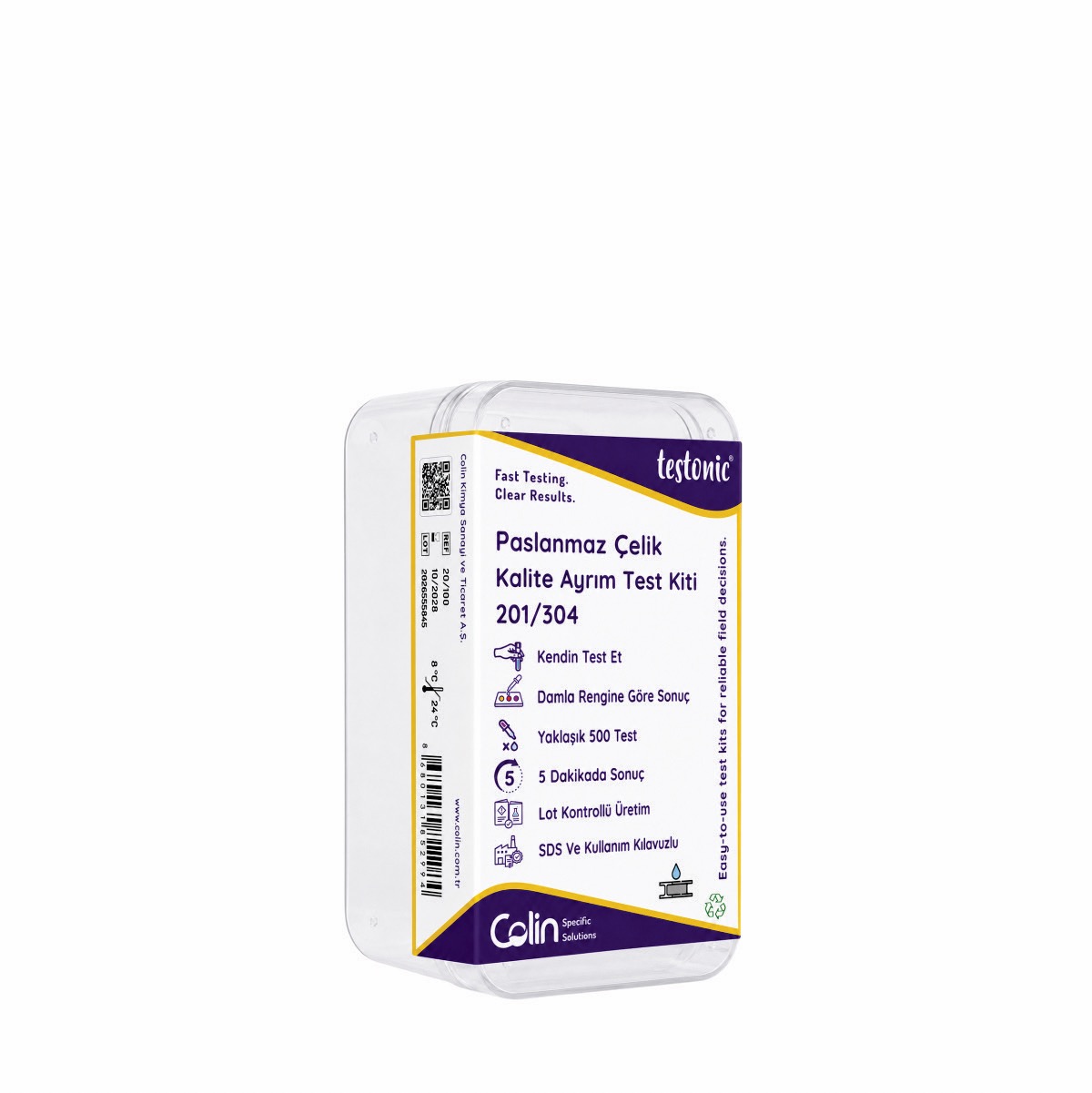
Testonic™ Stainless Steel Grade Identification Test Kit – 303/304 is a practical field test kit developed to help rapidly differentiate 303 and 304 grade stainless steel in stainless steel parts, bars, shafts, fittings, fasteners, and machined components.
303 and 304 grade stainless steels can look very similar. However, their alloy characteristics and typical applications are different. 303 stainless steel is commonly selected for machining applications requiring improved machinability, whereas 304 is widely used as a general-purpose stainless steel grade.
The Testonic™ 303/304 Test Kit uses differences in alloy composition and the resulting chemical reaction behavior to support rapid material identification in field conditions. This allows unlabeled, mixed-stock, or already-machined stainless steel components to be checked close to the point of production.
Is the stainless steel material 303 grade or 304 grade?
Why Is 303/304 Grade Differentiation Important?
Although 303 and 304 belong to the same austenitic stainless steel family, they are designed for different manufacturing and service requirements.
303 stainless steel contains added sulfur to improve machinability. This makes it especially suitable for automatic turning, CNC machining, screws, shafts, bushings, fittings, and precision-machined components.
304 stainless steel, on the other hand, is a widely used general-purpose stainless steel grade selected for forming, fabrication, welding, equipment manufacturing, and a broad range of industrial applications.
Because the two grades may appear very similar, mixing 303 and 304 during production can result in the wrong material being introduced into the wrong manufacturing process. The Testonic™ 303/304 Test Kit provides a rapid material verification method to help reduce this risk.
Helps quickly differentiate visually similar 303 and 304 grade stainless steels in field conditions.
Helps verify 303 grade stainless steel selected for high-machinability applications before or during production.
The result can be evaluated visually through the color reaction.
Provides a practical verification method for unlabeled or machined stainless steel parts.
Main Applications
- Quality control of stainless steel bars and shafts
- CNC machining facilities
- Automatic turning operations
- Machining workshops and production plants
- Screw, nut, and fastener manufacturing
- Shaft, bushing, and precision component production
- Valve and fitting components
- Machinery and equipment parts
- Incoming inspection of stainless steel raw materials
- Metal service centers and stock warehouses
- Supplier material verification
- Identification of mixed stainless steel components in production
- Maintenance and spare-part quality control
Product Features
| Control Purpose | Differentiation of 303 and 304 grade stainless steel |
| Sample Type | Stainless steel surface |
| Test Type | Chemical spot test |
| Result | 303/304 grade differentiation based on color reaction |
| Main Use | Incoming inspection, machining, production, warehouse, and field quality control |
| Evaluation | Visual |
| Instrument Requirement | No instrument required |
Why Is 303 Stainless Steel Different?
303 stainless steel is a free-machining austenitic stainless steel developed to improve machining performance.
The addition of sulfur promotes easier chip breaking, helps reduce cutting resistance, and supports higher machining efficiency, particularly in repetitive production. For this reason, 303 grade is widely used for turned, milled, and precision-machined components.
304 stainless steel is a general-purpose austenitic stainless steel with a much broader range of applications. Therefore, although the two materials may appear similar, knowing which grade is being used is important for correct production planning.
| Feature | 303 | 304 |
|---|---|---|
| Typical application approach | High-volume machining | General-purpose stainless steel applications |
| Machinability | High | Standard |
| Typical products | Shafts, bushings, screws, fittings, and turned components | Equipment, sheet, pipe, tanks, and general fabrication components |
Why Is It Useful in Machining Operations?
In machining facilities, correct stainless steel grade selection can directly affect machining speed, tool life, surface quality, and overall production efficiency.
If machining parameters are selected on the assumption that a component is 303 grade, but the material is actually 304, the expected machining behavior may not be achieved. Likewise, treating a 303 grade component as 304 can create unnecessary uncertainty in material selection and process planning.
The Testonic™ 303/304 Grade Identification Test Kit helps verify the material rapidly before or during machining, reducing the risk of such production mix-ups.
Who Is It Suitable For?
- CNC machining centers
- Automatic turning facilities
- Stainless steel component manufacturers
- Screw and fastener manufacturers
- Shaft and bushing manufacturers
- Valve and fitting manufacturers
- Machinery industry companies
- Metal service centers
- Stainless steel raw material suppliers
- Quality control departments
- Purchasing and incoming inspection teams
- Maintenance and technical service departments
Other Stainless Steel Grade Identification Tests
Where 201 or 316 grade materials are also used alongside 303 and 304 stainless steels, keeping the appropriate Testonic™ grade identification tests available together supports more comprehensive rapid material control from incoming inspection through production.
| Control Requirement | Recommended Testonic™ Product |
|---|---|
| Differentiation of 201 and 304 grade stainless steel | Testonic™ Stainless Steel Grade Identification Test Kit – 201/304 |
| Differentiation of 304 and 316 grade stainless steel | Testonic™ Stainless Steel Grade Identification Test Kit – 304/316 |
Where stainless steel grades such as 201, 303, 304, and 316 are used within the same facility, keeping the appropriate grade identification tests available helps simplify rapid material verification during purchasing, incoming inspection, stock management, and production.
Colin Quality and Technical Support
The Testonic™ 303/304 Stainless Steel Grade Identification Test Kit is manufactured by Colin Kimya to support rapid material verification, particularly in machining and stainless steel component production applications.
Where 303, 304, or other stainless steel grades are used within the same production environment, the appropriate Testonic™ grade identification kits can be used together to establish a more systematic rapid quality control approach from incoming raw material inspection through finished components. Colin's technical team can provide support for product selection and application.
Technical Documents
Technical Support and Product Consulting
You can use the form to find the most suitable chemical solution for your needs or to obtain detailed information about the technical specifications of our products.
Your requests are carefully reviewed and answered by Colin's expert team.
You can ask us about the product.