


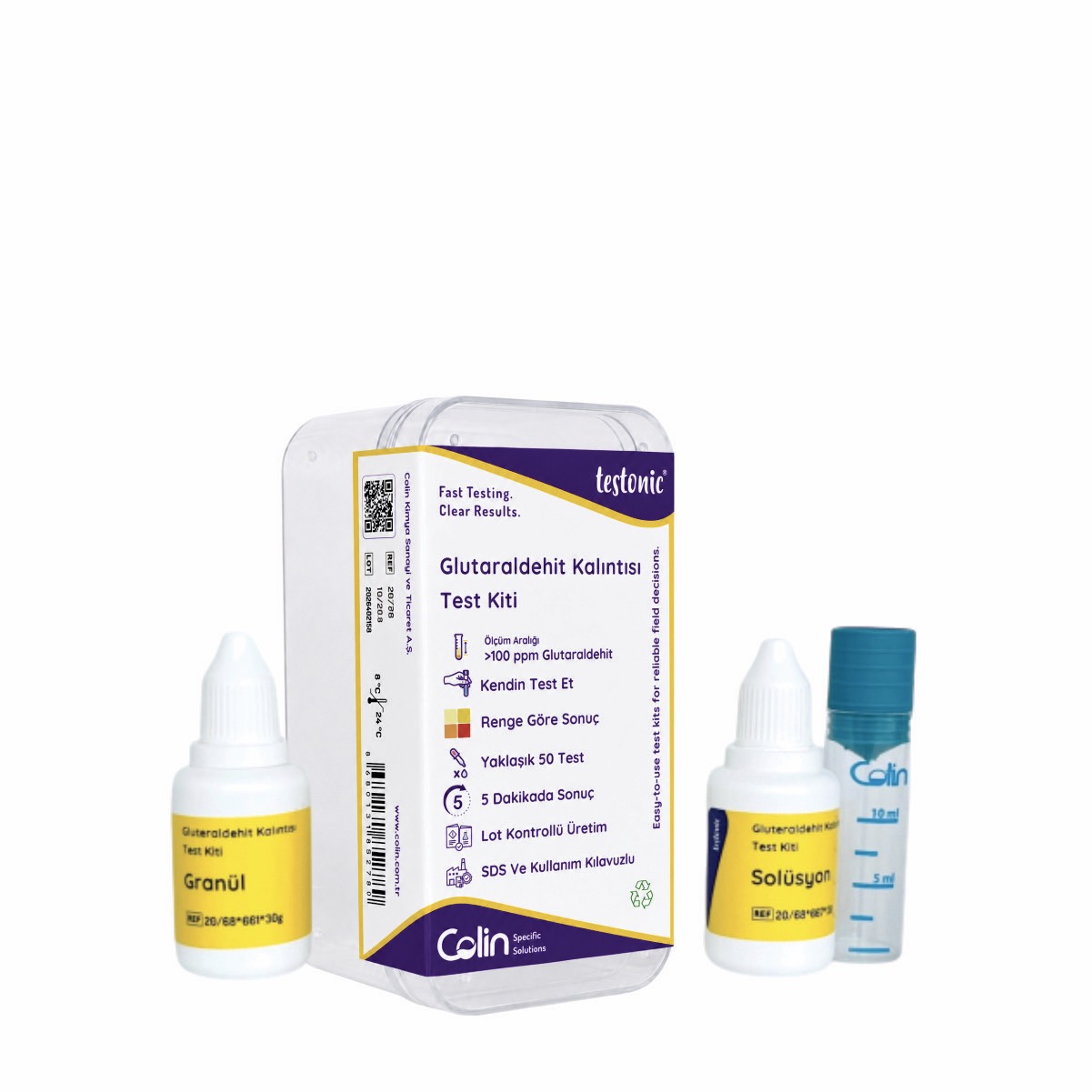
Testonic® Glutaraldehyde Residue Test Kit is designed for quick and practical detection of residual glutaraldehyde in water and suitable liquid samples after disinfection and sanitation processes involving glutaraldehyde-based products.
Ideal for residue monitoring after rinsing tanks, pipelines, equipment and industrial disinfection systems. The color reaction-based test method allows visual evaluation of glutaraldehyde residues above 100 ppm in approximately 5 minutes. No laboratory instrument is required, making it suitable for routine field and quality control applications.
Why Is Glutaraldehyde Residue Monitoring Important?
Glutaraldehyde is an active ingredient used in high-level disinfection and chemical sanitation applications. When rinsing is required after treatment, visual cleanliness alone is not sufficient; residual disinfectant chemicals should also be monitored. Glutaraldehyde residue testing makes it easier to evaluate rinsing effectiveness and perform post-disinfection process control.
Glutaraldehyde Residue Testing in 3 Easy Steps
- Prepare the Sample: Fill the graduated test tube with the specified volume of rinse water or a suitable liquid sample.
- Perform the Test: Apply the granules and test solution in the sequence and quantities specified in the instructions.
- Evaluate the Result: Compare the resulting color reaction with the reference evaluation information to check for glutaraldehyde residues.
Kit Contents
- Glutaraldehyde Test Granules
- Glutaraldehyde Test Solution
- 5/10 mL Graduated Test Tube
- Instructions for Use
Testonic® Glutaraldehyde Residue Test Kit – Post-Disinfection Monitoring
Testonic® Glutaraldehyde Residue Test Kit is a practical visual color reaction test designed for rapid monitoring of residual glutaraldehyde in water and suitable process liquids after disinfection and sanitation operations involving glutaraldehyde.
It is suitable for post-rinsing chemical residue monitoring in tanks, pipelines, equipment and industrial disinfection systems. The kit allows visual screening of glutaraldehyde residues above 100 ppm in approximately 5 minutes without specialized laboratory instruments.
Analytical Principle
The test is based on the visual evaluation of a color reaction produced when glutaraldehyde in the sample reacts with the kit reagents.
The granules and test solution are applied to the sample according to the product instructions. The resulting color is compared with the reference evaluation information.
The method is intended for rapid screening of glutaraldehyde residues above 100 ppm. It does not replace definitive concentration determination or sensitive laboratory measurement of trace-level residues.
Why Is Glutaraldehyde Residue Monitoring Important?
Glutaraldehyde is an active ingredient used in high-level disinfection and chemical sanitation processes. When rinsing is required after treatment, visual cleanliness alone is insufficient; residual glutaraldehyde should also be monitored.
Testonic® Glutaraldehyde Residue Test Kit provides a practical way to screen for residual active chemicals after disinfection and evaluate the rinsing process.
Three stages should be considered together:
- Disinfection: A glutaraldehyde-containing product is applied to the relevant equipment or system.
- Rinsing: Residual glutaraldehyde is intended to be removed according to process requirements.
- Residue Monitoring: Remaining glutaraldehyde in rinse water is evaluated using a color reaction.
Applications
- Equipment disinfection: Rinsing control after glutaraldehyde application.
- Tanks and pipelines: Monitoring residual active chemicals after disinfection.
- Industrial sanitation: Liquid sample monitoring in processes involving glutaraldehyde.
- Veterinary hygiene applications: Evaluation of equipment and suitable rinse water samples.
- Laboratory and technical equipment: Residue screening after chemical disinfection.
- Quality control: Routine rinsing and process verification applications.
How to Use
- Sample Preparation: Fill the graduated test tube with the volume of rinse water or suitable liquid sample specified in the instructions.
- Reagent Application: Apply the granules and test solution in the sequence and quantities specified in the instructions. Mix the sample as directed.
- Result Evaluation: Compare the resulting color reaction with the reference evaluation information to check for glutaraldehyde residues.
Note: Follow the product instructions for sample volume, reagent quantities, application sequence and reaction time.
Technical Specifications
| Property | Description |
| Test Parameter | Glutaraldehyde residues |
| Analytical Method | Visual color reaction |
| Result Type | Qualitative residue screening |
| Screening Level | Glutaraldehyde above 100 ppm |
| Sample Type | Rinse water and suitable liquid process samples |
| Application | Post-disinfection residue monitoring |
| Test Time | Approximately 5 minutes |
| Test Capacity | Approximately 50 tests |
| Instrument Required | No |
| Storage Temperature | 8–24 °C |
| Kit Contents | Test granules, test solution, 5/10 mL graduated test tube and instructions for use |
Interpretation of Results
The resulting color is compared with the reference evaluation information supplied with the product.
- Positive reaction: Indicates a color reaction consistent with glutaraldehyde residues above 100 ppm under the test conditions.
- Negative or below-threshold result: Indicates that no significant glutaraldehyde reaction was observed under the test conditions. It does not prove the complete absence of glutaraldehyde.
- Comparative monitoring: Samples collected at different rinsing stages can be compared using the same method.
Result acceptability should be evaluated according to the operator's process limits and the application instructions of the disinfectant used.
Analytical Interferences and Measurement Limitations
- Other reactive chemicals present in the sample may affect the test's color reaction.
- Highly colored or turbid samples may make visual interpretation difficult.
- Sample pH and the composition of process chemicals may cause analytical interference.
- The method is not intended for sensitive determination of glutaraldehyde concentrations below 100 ppm.
- The test does not replace quantitative laboratory analysis for definitive glutaraldehyde concentration determination.
Related Residue and Hygiene Parameters
Post-disinfection residue tests should be selected according to the type of active chemical used. Different disinfectants require different test methods.
| Control Parameter | Testonic® Test Kit |
| Glutaraldehyde residues | Glutaraldehyde Residue Test Kit |
| QAC / cationic detergent residues | QAC / Cationic Detergent Residue Test Kit |
| Chlorhexidine residues | Chlorhexidine (CHX) Residue Test Kit |
| Hypochlorite residues | Hypochlorite Residue Test Kit |
| Hydrogen peroxide residues | Active Oxygen Residue Test Kit |
| Protein residues | Protein Residue Test Kit |
Important Application Notes
- Use a clean test tube for each measurement.
- Apply the granules and test solution in the quantities specified in the instructions.
- Evaluate the color after the required reaction time.
- Determine rinsing requirements according to the application instructions of the disinfectant used.
- Use a method suitable for lower concentrations when monitoring residues below 100 ppm is required.
- Do not interpret the result as proof of microbiological disinfection effectiveness or sterility.
Frequently Asked Questions
Technical Documents
Related Posts
Related News
Technical Support and Product Consulting
Customer Questions & Expert Answers
For which applications is this kit suitable?
How long does it take to get the test results?
What does this kit measure?
Does this kit measure the effectiveness of glutaraldehyde-based disinfectant?
You can ask us about the product.
