


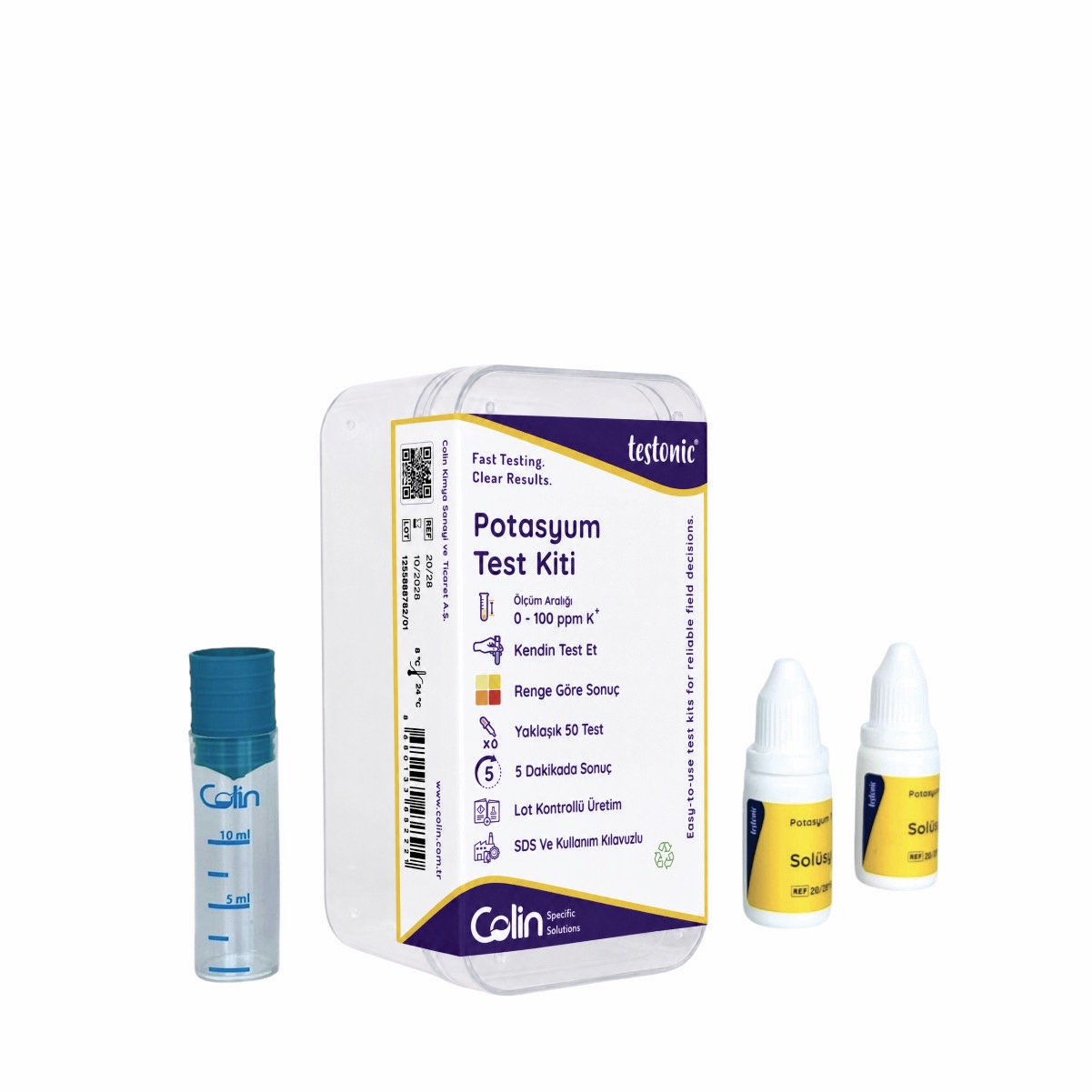
Testonic® Potassium Test Kit is designed for the rapid and convenient determination of potassium (K+) ions in water samples. It helps monitor potassium concentrations, evaluate water sources, and support water quality control and plant nutrition management.
The kit is suitable for potassium monitoring in irrigation water, greenhouse cultivation, hydroponic systems, plant nutrient solutions, aquariums, and process water. Its colorimetric color-comparison method allows testing without laboratory instruments. After adding the test reagents, the developed color is compared with the supplied color scale to determine the potassium level in approximately 5 minutes.
It provides a convenient and cost-effective solution for tracking potassium levels in nutrient solutions, checking the mineral content of water, and supporting routine monitoring of water-based applications.
Why Is Potassium Testing Important?
Potassium is an essential element involved in plant growth, water regulation, and nutrient utilization. Knowing the potassium content of irrigation water and nutrient solutions helps support better-controlled plant nutrition practices. In natural and industrial waters, potassium is also a useful parameter for evaluating mineral composition. Regular potassium testing makes it easier to monitor water quality and nutrient solutions over time.
Potassium Testing in 3 Simple Steps
- Prepare the Sample: Fill the graduated test vial with the water sample to the level specified in the instructions.
- Perform the Test: Add the potassium test reagents in the sequence specified in the instruction manual.
- Read the Result: Compare the developed color with the supplied color scale to determine the potassium level.
Package Contents
- Potassium test reagents (2 solutions)
- 5/10 mL graduated test vial
- Color comparison scale
- Instruction manual
Testonic® Potassium Test Kit provides a practical colorimetric method for determining potassium ions (K+) in water samples. It is suitable for potassium monitoring in irrigation water, hydroponic cultivation, plant nutrient solutions, aquariums, and industrial water applications.
Results are read directly from a color comparison scale, allowing on-site testing without a spectrophotometer or other laboratory instruments. Results obtained in approximately 5 minutes help evaluate the mineral content of water and monitor changes in potassium concentration.
Analytical Principle
Potassium occurs in water as dissolved K+ ions. In colorimetric analysis, the visual response produced by applying the test reagents to the sample is used to determine potassium concentration. The resulting sample color is evaluated against the reference color scale supplied with the kit.
The color comparison method allows testing without laboratory instruments. The potassium concentration is read in ppm K+ by selecting the closest matching value on the reference scale.
Why Measure Potassium?
Potassium is an essential nutrient for plant growth. It plays important roles in water regulation, enzyme activity, and other physiological processes. Knowing the potassium content of irrigation water and nutrient solutions helps support the monitoring of plant nutrition practices.
Potassium is also one of the dissolved mineral constituents present in natural water. Its measurement can therefore provide useful information in applications where water composition is monitored.
- Greenhouses: Monitoring potassium in irrigation water and plant nutrient solutions.
- Hydroponic cultivation: Tracking the potassium content of nutrient solutions.
- Agricultural irrigation: Determining potassium levels in irrigation water.
- Aquariums: Monitoring potassium concentrations in planted aquariums.
- Well and source water: Comparing the mineral composition of different water sources.
- Industrial processes: Routine testing where potassium monitoring is required.
How to Perform the Test
Fill the clean test vial with the water sample to the level specified in the instruction manual.
Apply the potassium test reagents in the specified sequence and amounts.
Compare the developed color with the reference scale to determine the potassium concentration.
Technical Specifications
| Measured parameter | Potassium ion (K+) |
| Analytical method | Colorimetric, visual color comparison |
| Measuring range | 0 – 100 ppm K+ |
| Result reading | Reference color scale |
| Test time | Approx. 5 minutes |
| Test capacity | Approx. 50 tests |
| Kit components | 2 test solutions, test vial, color scale, and instruction manual |
| Storage temperature | 8 – 24 °C |
Interpreting the Results
The developed sample color is compared with the reference color scale. The closest matching scale value indicates the potassium concentration. Results are expressed in ppm K+.
In dilute aqueous solutions, 1 ppm K+ is approximately equivalent to 1 mg/L potassium. For example, a reading of 40 ppm corresponds to approximately 40 mg/L potassium.
Whether a measured value is sufficient or high depends on the intended application. Target potassium concentrations may vary according to plant species, cultivation methods, and the nutrient solution being used.
Related Water Quality Parameters
| Parameter | What It Indicates |
|---|---|
| Potassium (K+) | Potassium ion concentration in water |
| Nitrate (NO3−) | Dissolved nitrogen-containing nutrient |
| Phosphate (PO43−) | Dissolved phosphorus-containing nutrient |
| pH | Acidity and alkalinity condition of water |
| Electrical Conductivity (EC) | Indicator of the overall ionic content of a solution |
Important Usage Notes
- Use a clean test vial for each measurement.
- Add the reagents in the sequence and quantities specified in the instruction manual.
- Compare colors under suitable lighting conditions.
- Evaluate test results against the target levels for the intended application.
- Keep reagent containers closed and store them within the specified temperature range.
Frequently Asked Questions
It measures the concentration of potassium ions (K+) in water samples and displays the result in ppm.
Potassium is an essential nutrient involved in plant water regulation, enzyme activity, and growth processes.
It can be used to monitor potassium levels in nutrient solution samples that fall within the measuring range and are compatible with the test procedure.
Potassium is one of the nutrients monitored in planted aquariums. Regular testing helps track changes in its concentration.
No. Electrical conductivity indicates the overall conductivity of a solution and does not determine potassium concentration separately.
No. The test result is read visually using the color scale supplied with the kit.
The kit provides approximately 50 tests. Actual capacity depends on the procedure and reagent quantities used.
For Drinking Water Production Facilities
Monitoring potassium levels in drinking water plays a critical role in ensuring water quality and safety. The Potassium Test Kit allows easy checking of compliance with standards in water treatment and distribution processes.
Pollution Monitoring and Water Quality Testing for Environmental and Wastewater Management
Measuring potassium concentration in wastewater or environmental water sources is an important indicator in assessing pollution levels. This test kit can be used as an effective monitoring tool in combating environmental pollution.
Test and Process Control Kits for Textile Finishing and Dyeing Mills
Checks potassium in process-water or auxiliary samples, useful for special formulation, salt balance and contamination assessments.
Technical Documents
Related Posts
Related News
Technical Support and Product Consulting
You can use the form to find the most suitable chemical solution for your needs or to obtain detailed information about the technical specifications of our products.
Your requests are carefully reviewed and answered by Colin's expert team.
You can ask us about the product.
