


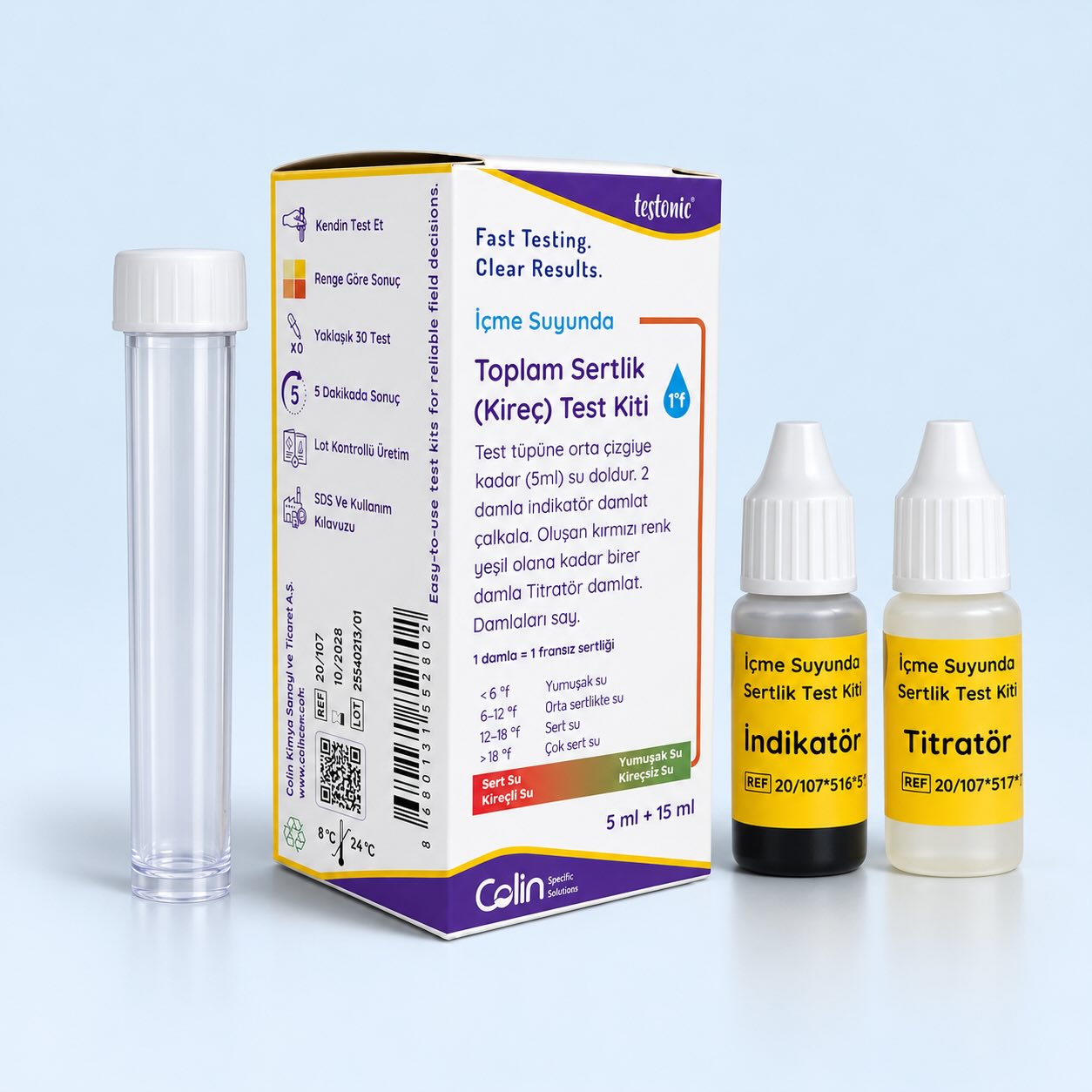
Testonic® Drinking Water Total Hardness (Scale) Test Kit allows you to easily measure total water hardness caused by calcium and magnesium ions at home. Check the hardness of tap, well, and treated water, assess scaling potential, and monitor the performance of your water softening system.
Suitable for testing water used in homes, water purification systems, kettles, coffee machines, water heaters, and household appliances affected by scale formation. The drop-count and colour-change method requires no laboratory instruments or specialist training. Simply observe the colour change from red to green to obtain a result in approximately 5 minutes.
Each kit provides approximately 30 tests, making it convenient to compare different water sources and monitor changes in water treatment performance over time.
Why Is Water Hardness Important?
Hard water can contribute to mineral scale deposits in kettles, coffee machines, water heaters, taps, and plumbing under suitable conditions. These deposits may increase maintenance requirements and affect heating efficiency. Regular hardness testing helps you assess scaling potential and monitor whether your water softening system is performing as expected.
Testing in 3 Simple Steps
- Prepare the Sample: Fill the test tube with 5 mL of water up to the middle graduation mark.
- Add the Indicator: Add 2 drops of indicator solution and shake gently to mix.
- Read the Result: Add titrant solution one drop at a time until the colour changes from red to green. Count the titrant drops used. Each drop represents 1 French degree (1 °f) of hardness.
Package Contents
- Total Hardness Indicator Solution
- Total Hardness Titrant Solution (1 °f)
- Graduated Measuring Tube
- Instruction Manual
Water hardness is primarily caused by dissolved calcium (Ca2+) and magnesium (Mg2+) ions. Under suitable temperature and chemical conditions, these minerals can contribute to scale deposits in kettles, water heaters, coffee machines, and plumbing systems.
The Testonic® Drinking Water Total Hardness (Scale) Test Kit is designed for convenient household water testing without analytical instruments. It uses a drop-count titration method in which each titrant drop corresponds to 1 French degree of hardness (1 °f).
Analytical Principle
The measurement is based on indicator-assisted drop titration. The combined hardness contribution of calcium and magnesium ions is determined from the amount of titrant required to reach the visual endpoint.
The indicator produces an initial red colour. Titrant solution is added drop by drop until the sample changes from red to green.
The number of titrant drops required to reach the endpoint directly indicates total hardness in French degrees (°f).
Why Should Water Hardness Be Measured?
Knowing the hardness of household water helps assess scaling potential and monitor the performance of water treatment systems.
Main applications:
- Tap water: Determining the hardness of municipal water used at home.
- Water purification systems: Comparing hardness before and after treatment.
- Water softeners: Monitoring the effect of softening on water hardness.
- Kettles and coffee machines: Evaluating the hardness of water used in appliances affected by scale.
- Water heaters and household appliances: Monitoring mineral hardness associated with scale formation on heating surfaces.
- Well and spring water: Comparing hardness levels from different sources.
How Does the Test Work?
Technical Specifications
| Measured parameter | Total water hardness |
| Analytical method | Visual colour-endpoint drop titration |
| Drop factor | 1 drop = 1 °f |
| Nominal reading increment | 1 °f |
| CaCO3 equivalent | 1 °f = 10 mg/L CaCO3 |
| Sample volume | 5 mL |
| Endpoint colour change | Red to green |
| Analysis time | Approximately 5 minutes |
| Test capacity | Approximately 30 tests |
| Reagent packaging | 5 mL + 15 mL |
| Storage conditions | 8–24 °C |
Calculation of Results
Total hardness is determined directly from the number of titrant drops required to reach the colour-change endpoint.
Total Hardness (°f) = Number of Titrant Drops × 1
Example: If the endpoint is reached after 15 drops, total hardness is 15 °f. This corresponds to 150 mg/L total hardness expressed as CaCO3.
Common hardness conversions:
- 1 °f = 10 mg/L CaCO3
- 1 °f ≈ 0.56 °dH German hardness
- 1 °dH ≈ 1.79 °f French hardness
How Are Water Hardness Levels Classified?
The product packaging provides the following practical hardness classification guide for household use:
| Hardness (°f) | CaCO3 (mg/L) | Classification |
|---|---|---|
| Below 6 °f | Below 60 | Soft water |
| 6–12 °f | 60–120 | Moderately hard water |
| 12–18 °f | 120–180 | Hard water |
| Above 18 °f | Above 180 | Very hard water |
This classification is a practical interpretation guide provided on the product packaging. Hardness classifications may vary between reference systems. Actual scaling potential also depends on pH, alkalinity, temperature, and other water chemistry conditions.
Analytical Interferences and Limitations
- Sample colour and turbidity: Strongly coloured or turbid samples may make the red-to-green endpoint difficult to identify.
- Other metal ions: Certain metal ions may interfere depending on analytical conditions.
- Complexing agents: Chemicals that bind calcium and magnesium may affect measurement results.
- pH: Strongly acidic or alkaline samples may influence titration conditions.
- Very low hardness: The nominal 1 °f reading increment may not provide sufficient differentiation at very low hardness levels.
Important Usage Notes
- Use a clean measuring tube and fill it to the 5 mL graduation mark.
- Do not interchange the indicator and titrant droppers.
- Hold the dropper vertically and count titrant drops consistently.
- Mix the sample after each drop and observe the permanent colour change.
- Higher hardness may increase titrant consumption, so the number of available tests can vary.
- Store the product within the labelled temperature range of 8–24 °C.
Frequently Asked Questions
1. How can I test water hardness at home?
Fill the test tube with 5 mL of water and add 2 drops of indicator. Add titrant until the colour changes from red to green. The number of titrant drops gives hardness in French degrees (°f).
2. Does hard water mean the water is unsafe to drink?
No. Hardness alone does not determine drinking water safety. Microbiological quality and other chemical parameters must also be considered.
3. Can this test show whether my water purifier is working?
Hardness can be compared before and after treatment. A reduction is expected in systems designed to soften water. However, hardness testing alone does not confirm the removal of all contaminants.
4. Are water hardness and TDS the same?
No. Hardness primarily represents calcium and magnesium contributions, while TDS refers to total dissolved solids. TDS measurement cannot directly replace a hardness test.
5. Does boiling water remove all hardness?
Boiling may reduce some temporary hardness through mineral precipitation, but it does not remove all substances responsible for total hardness.
6. How many ppm is 1 French degree of hardness?
One French degree (1 °f) equals 10 mg/L total hardness expressed as CaCO3. For example, a measurement requiring 12 titrant drops corresponds to 12 °f or 120 mg/L as CaCO3.
Test and Process Control Kits for Textile Finishing and Dyeing Mills
Helps monitor calcium-magnesium hardness in process water and dye bath preparation, supporting control of dye uptake, spotting and scale-related risks.
Technical Documents
Related Posts
Related News
Technical Support and Product Consulting
You can use the form to find the most suitable chemical solution for your needs or to obtain detailed information about the technical specifications of our products.
Your requests are carefully reviewed and answered by Colin's expert team.
You can ask us about the product.
