


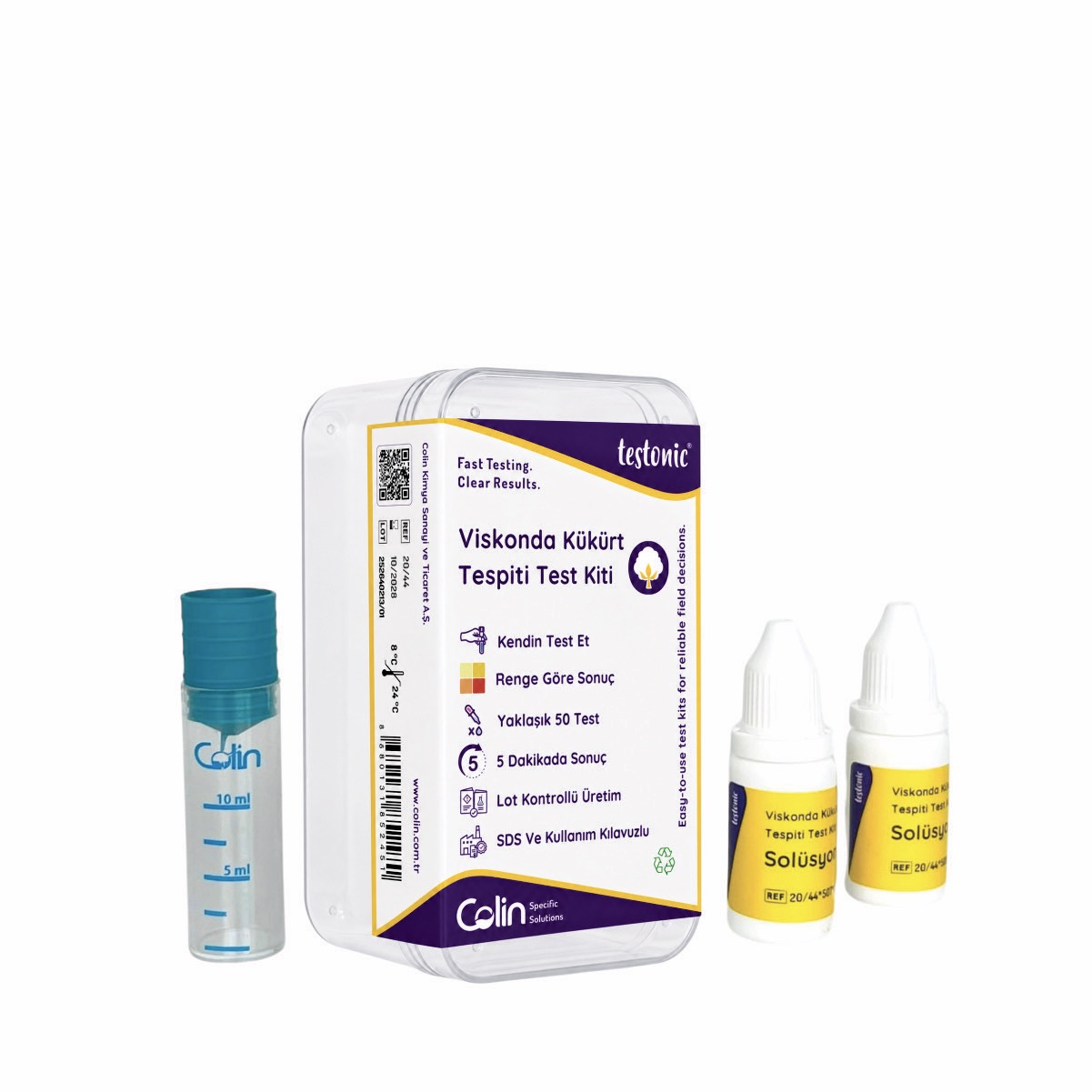
Testonic® Sulfur Detection Test Kit for Viscose is designed for the rapid screening of sulfur-related residues in raw viscose yarns, knitted fabrics, and woven fabrics. It is particularly useful for comparing different viscose batches and raw materials received from different suppliers.
Different viscose batches may produce different results even when the same dyeing recipe and process conditions are used. The Testonic® Sulfur Detection Test Kit for Viscose allows operators to compare incoming batches with a proven reference material and identify raw material differences before production. The color-based test provides results in approximately 5 minutes.
Why Is Sulfur Monitoring Important in Viscose?
Residues originating from sulfur-containing chemicals used in viscose manufacturing may vary between producers and production batches. These differences are useful parameters when investigating raw material variability in textile finishing processes.
Comparing new viscose batches with a reference material allows more informed evaluation of pretreatment, scouring, whiteness, and dyeing results.
Viscose Testing in 3 Easy Steps
- Prepare the Sample: Prepare the viscose yarn or fabric sample according to the instructions for use.
- Perform the Test: Add the test solutions in the specified sequence and observe the color development.
- Compare the Result: Evaluate the developed color and compare the result of the new batch with that of a proven reference viscose material.
Kit Contents
- Sulfur Detection Test Solutions for Viscose (2 Bottles)
- Graduated Test Tube
- Instructions for Use
Testonic® Sulfur Detection Test Kit for Viscose is designed for the rapid screening of sulfur-related residues in raw viscose yarns, knitted fabrics, and woven fabrics. It is suitable for incoming raw material inspection, pretreatment planning, and quality control before dyeing.
Different viscose batches may produce different results even when the same dyeing recipe and machine conditions are used. Chemical differences originating from raw material manufacturing may contribute to this variability. The Testonic® Sulfur Detection Test Kit for Viscose makes it easier to compare incoming materials with a proven reference batch before production.
Why Is Sulfur Monitoring Important in Viscose?
Sulfur-containing chemicals are used during viscose fiber manufacturing. Despite subsequent purification and washing processes, sulfur-related residue profiles may vary between manufacturers, production lines, and batches.
In textile finishing operations, these differences may be considered when investigating pretreatment performance, whiteness after scouring, color yield, shade reproducibility, and fabric appearance.
When one viscose batch performs consistently while another produces recurring process differences, comparing their test results can help investigate potential raw material variability.
Applications
- Incoming Raw Material Inspection: Checking new viscose batches before production.
- Batch Comparison: Comparing incoming viscose materials with reference batches.
- Supplier Evaluation: Comparing viscose materials from different sources.
- Pretreatment and Scouring: Evaluating raw material differences alongside preparation processes.
- Dyeing Preparation: Checking viscose batches that perform differently under the same dyeing recipe.
- Quality Investigation: Reviewing raw material differences associated with shade, whiteness, and color yield variations.
Viscose Testing in 3 Easy Steps
- Prepare the Sample: Prepare the viscose yarn or fabric sample as specified in the instructions for use.
- Perform the Test: Add the test solutions in the specified sequence and observe the color development.
- Compare the Result: Record the color result and compare the new batch with a reference viscose material known to perform consistently.
Technical Specifications
| Product Name | Testonic® Sulfur Detection Test Kit for Viscose |
| Target Parameter | Sulfur-related residues in viscose |
| Sample Type | Raw viscose yarn, knitted and woven fabrics |
| Result Reading | Visual color-change assessment |
| Main Application | Comparative quality control of viscose batches |
| Reagent System | 2 test solutions |
| Analysis Time | Approximately 5 minutes |
| Test Capacity | Approximately 50 tests |
| Storage Temperature | 8–24 °C |
| Equipment Required | No laboratory instruments required |
Interpretation of Results
The test result is assessed through the color change observed in the prepared sample. A useful approach is to compare each incoming viscose batch with a reference batch that has previously performed well in production.
| Comparison Result | Operational Evaluation |
|---|---|
| Color similar to reference batch | A similar raw material profile is observed for the parameter being checked. |
| Color different from reference batch | The raw material difference can be evaluated alongside pretreatment and dyeing performance. |
Which Production Issues Can Be Investigated?
| Observed Issue | Use of the Test |
|---|---|
| Shade Differences Between Batches | Compare sulfur-related residue results from problematic and reference batches. |
| Whiteness and Yellow Undertone Differences | Evaluate raw material test results together with scouring and whiteness checks. |
| Variation in Color Yield | Compare raw material profiles of batches giving different results with the same recipe. |
| Supplier Change | Compare viscose from different suppliers with a reference material. |
Comparison with a Reference Batch
Selecting a viscose batch that has previously performed consistently as a reference raw material makes incoming batch evaluation more practical.
When test results are recorded together with supplier, batch number, whiteness, absorbency, pretreatment conditions, and actual dyeing performance, a company-specific raw material quality profile can be developed over time.
Related Textile Control Parameters
- Absorbency Control: Evaluation of fabric wettability and absorbency.
- Peroxide Residue After Scouring: Checking residual hydrogen peroxide after pretreatment.
- Size Residue Control: Checking starch and other sizing materials on fabrics.
- Sugar Control in Cotton: Investigating sugar content and stickiness risk in raw cotton.
- Pretreatment and Whiteness Control: Comparing raw material differences with process results.
Important Usage Notes
- Evaluate viscose samples under consistent test conditions for meaningful comparisons.
- Follow the product instructions for sample preparation and reagent addition.
- Record results together with supplier and batch information.
- Review raw material results alongside pretreatment and dyeing performance.
Frequently Asked Questions
For Textile Finishing and Dyeing Businesses
Detection of sulfur residues on viscose fiber is a critical analysis to improve color stability and textile quality in dyeing and finishing processes.
Test and Process Control Kits for Textile Finishing and Dyeing Mills
Investigates sulfur/sulfide-related residues in fibers such as viscose/modal, supporting analysis of dyeing problems, odor and process incompatibilities.
Technical Documents
Technical Support and Product Consulting
Customer Questions & Expert Answers
Cotton / Viscose Filtration Preparation
You can ask us about the product.
