

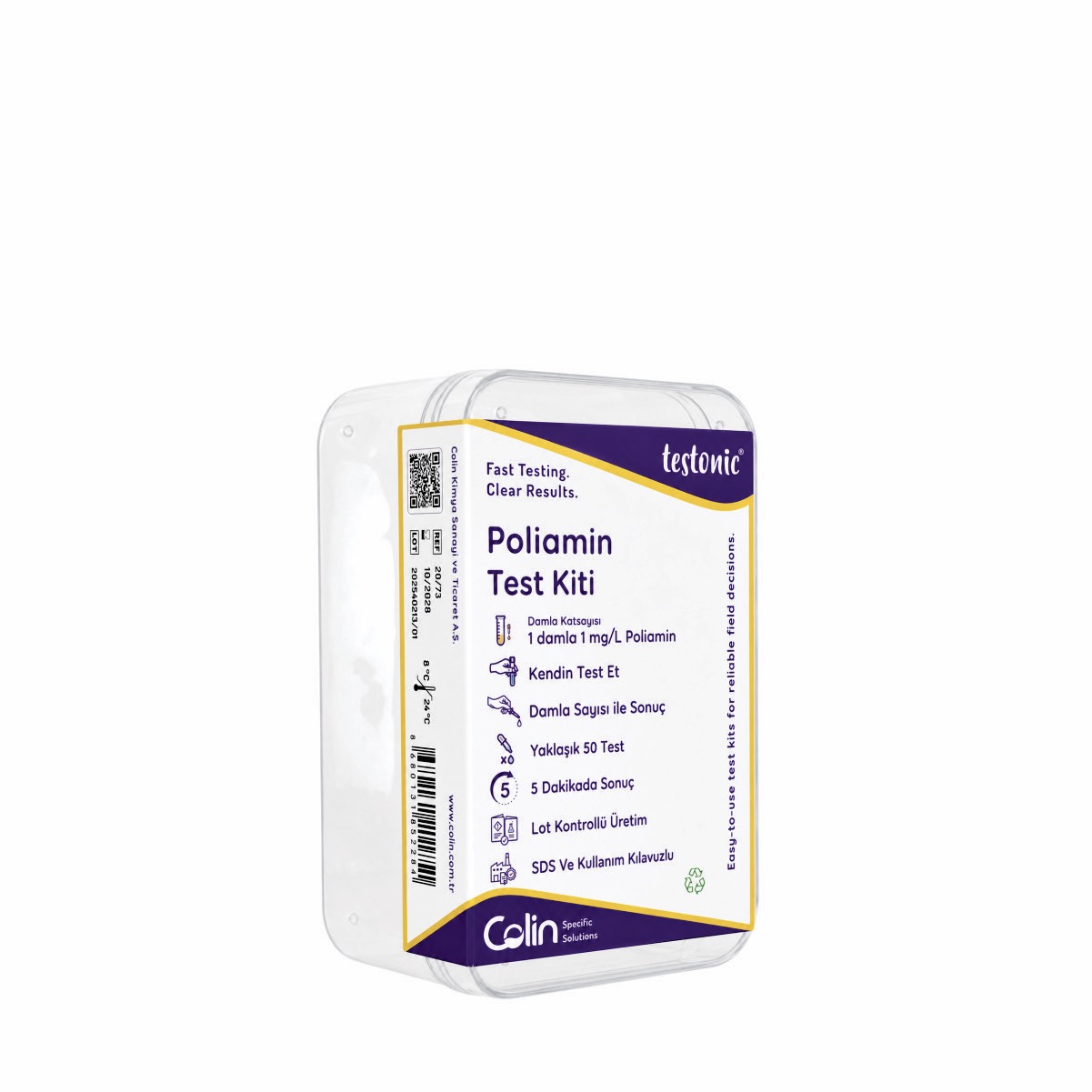
Testonic® Polyamine Test Kit is designed for the rapid and practical determination of polyamine and cationic polymer levels in water and process solutions. Its drop-count colorimetric titration method allows convenient testing without laboratory instruments.
The kit is suitable for monitoring polyamine-based chemicals used in cooling water, boiler water, industrial water treatment, and textile processes. Results reflect the overall cationic charge of responsive compounds in the sample and are expressed as mg/L (ppm) polyamine equivalent. Results are available in approximately 5 minutes.
Why Is Polyamine Monitoring Important?
Polyamines and cationic polymers are used in water conditioning, corrosion control, and treatment processes. Insufficient or excessive chemical dosing may affect process performance and operating costs. Regular polyamine testing helps operators monitor chemical usage and assess dosing adjustments.
Polyamine Measurement in 3 Easy Steps
- Prepare the Sample: Add the specified volume of water or process sample to the test vessel as directed in the instructions.
- Perform the Test: Add the indicator. Then add the titrant solution drop by drop while mixing the sample.
- Read the Result: Count the titrant drops required to complete the characteristic color change. Under standard test conditions, each drop corresponds to 1 mg/L polyamine equivalent.
Kit Contents
- Polyamine Test Reagents
- Measurement Accessories for Drop Titration
- Instructions for Use
Testonic® Polyamine Test Kit is a colorimetric titration kit designed for the practical determination of polyamines and cationic polymers in industrial water and process solutions. It is particularly suitable for chemical dosing control and process monitoring in water treatment applications.
The test evaluates the overall charge of responsive cationic compounds in the sample. Its drop-count titration method provides results in approximately 5 minutes without laboratory instruments. Results are expressed as mg/L (ppm) polyamine equivalent.
Analytical Principle
The Polyamine Test Kit is based on anionic polyelectrolyte titration (colloid titration). Positively charged polyamines and cationic polymers in the sample interact with an oppositely charged reagent during titration.
The endpoint of charge neutralization is detected through a characteristic indicator color change. The amount of titrant consumed is used to calculate the total responsive cationic charge expressed as polyamine equivalent.
The method does not identify individual polyamine molecules. Different cationic compounds may contribute to the measured result depending on their chemical structures and test conditions.
Why Is Polyamine Monitoring Important?
Polyamine-based chemicals are used in cooling water, boiler water, and various industrial processes for corrosion control and water conditioning. Monitoring their levels is important when evaluating chemical dosing.
Regular polyamine analysis makes it easier to monitor changes in chemical consumption, compare process conditions, and reduce unnecessary chemical usage.
Applications
- Cooling Water Systems: Monitoring polyamine-based conditioning chemicals in open and closed circuits.
- Boiler and Condensate Systems: Process monitoring of suitable amine and polyamine treatment programs.
- Industrial Water Conditioning: Monitoring cationic chemical dosing.
- Wastewater Treatment: Process control where polyamines and cationic flocculants are used.
- Textile Industry: Monitoring cationic compounds in process water and suitable chemical solutions.
- Chemical and Polymer Industry: Comparative analysis of appropriately prepared polyamine and cationic polymer solutions.
- Quality Control Laboratories: Routine checks of polyamine-containing products and process samples.
How to Use
- Prepare the Sample: Add the specified volume of water or suitable process solution to a clean test vessel according to the instructions for use.
- Perform the Titration: Add the indicator. Then add the titrant solution drop by drop, mixing the sample after each addition.
- Calculate the Result: Stop the titration at the persistent endpoint color change and count the drops. Under standard test conditions, multiply the drop count by 1 mg/L to obtain the polyamine-equivalent result.
Technical Specifications
| Product Name | Testonic® Polyamine Test Kit |
| Measured Parameter | Total charge of polyamines and responsive cationic compounds |
| Test Method | Colorimetric colloid titration |
| Result Unit | mg/L (ppm) polyamine equivalent |
| Drop Factor | 1 drop = 1 mg/L polyamine equivalent (standard sample volume) |
| Result Reading | Color change and drop counting |
| Analysis Time | Approximately 5 minutes |
| Test Capacity | Approximately 50 tests |
| Sample Type | Water and suitable process solutions |
| Use Environment | Field and laboratory |
Interpretation of Results
Observe the indicator color change during titrant addition. Under the specified standard sample volume and test conditions, calculate the result as follows:
For example, if 12 drops are required to reach the endpoint, the result is 12 mg/L polyamine equivalent.
This value represents the equivalent concentration corresponding to the total responsive cationic charge. It does not, by itself, establish that only one polyamine species is present or that its actual mass concentration is identical to the reported value.
Analytical Interferences and Measurement Limitations
- Chemical Selectivity: The test is not specific to a single polyamine molecule. Other cationic polymers and responsive cationic substances may affect the result.
- pH Effect: The charge state of amine groups may vary with pH, making consistent test conditions important.
- Anionic Components: Anionic polymers and certain surfactants may interact with cationic substances and influence the measurement.
- Salinity and Ionic Strength: High salt concentrations may affect polymer interactions and the titration endpoint.
- Colored or Turbid Samples: Strong sample coloration and turbidity may make visual endpoint detection more difficult.
- Different Polyamine Types: Polymers with different structures and charge densities may produce the same titration result at different actual mass concentrations.
Note: Method suitability should be checked for highly saline, concentrated, or complex chemical samples. A suitable reference method should be used when compound-specific concentration determination is required.
Related Residue and Process Control Parameters
- Cationic polymer and polyelectrolyte concentration
- Polyamine-based corrosion inhibitors
- Water treatment chemical dosing
- Cooling and boiler water process control
- Process balance of anionic and cationic auxiliaries
Important Usage Notes
- Follow the product instructions for sample volume and reagent addition sequence.
- Apply the drop factor only at the specified standard sample volume.
- Mix the sample after each titrant drop and use the persistent color change as the endpoint.
- Account for the dilution factor when testing diluted samples.
- Consider differences in chemical structure and charge density when comparing different polyamine products.
Frequently Asked Questions
Test and Process Control Kits for Textile Finishing and Dyeing Mills
Monitors polyamine-based fixatives or cationic auxiliaries, supporting dosing and residual control in fixation, rinsing and wastewater processes.
Technical Documents
Related Posts
Related News
Technical Support and Product Consulting
You can use the form to find the most suitable chemical solution for your needs or to obtain detailed information about the technical specifications of our products.
Your requests are carefully reviewed and answered by Colin's expert team.
You can ask us about the product.