

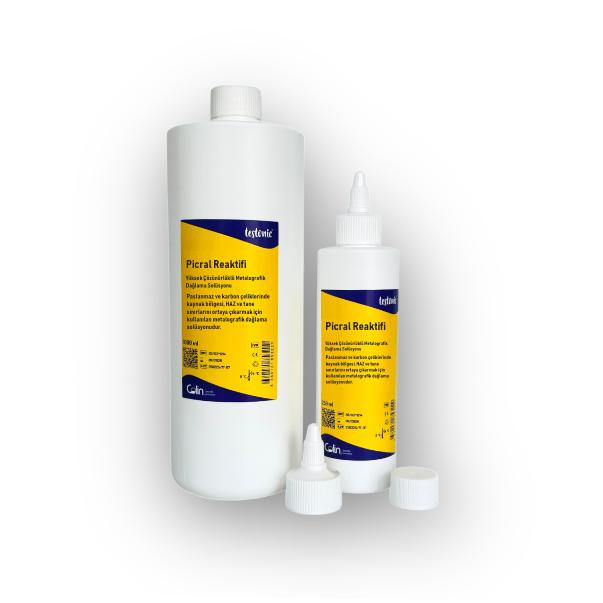
Testonic™ Picral Reagent is a metallographic etching solution developed to help make cementite, carbides, and ferrite-carbide structures more clearly visible in carbon steels, cast irons, and carbide-containing ferrous alloys.
In metallographic examination, the distribution, morphology, and relationship of carbides with the surrounding microstructure may be critical to understanding material behavior. Picral provides strong microstructural contrast in carbide- and cementite-containing regions, helping these structures become easier to evaluate under the microscope.
For this reason, Picral is valuable not only in routine steel examination, but also in metallurgical studies involving heat treatment, carburizing, tool steels, cast irons, and applications where carbide distribution is important.
To make cementite, carbides, pearlite, and ferrite-carbide microstructures more clearly visible under a metallurgical microscope in steels and ferrous alloys.
Why Use Picral?
Cementite and other carbide phases in steels and cast irons play an important role in hardness, wear resistance, machinability, and heat-treatment behavior.
Picral helps distinguish these carbide-rich areas from the surrounding matrix, making carbide distribution and ferrite-carbide relationships more clearly visible.
For laboratories that need to evaluate not only the general phase structure but also carbide morphology and distribution, Picral is an important metallographic etchant that complements Nital.
Helps make cementite and other carbide structures easier to observe under the microscope.
Facilitates evaluation of pearlitic regions and ferrite-carbide relationships.
Helps examine changes in carbide distribution and morphology after heat treatment.
Provides an advantage when examining carbide- and cementite-containing structures in greater detail.
Which Structures Are Best Examined with Picral?
Picral is especially useful when carbide phases need to be emphasized during metallographic evaluation.
Typical structures include cementite, pearlite, carbide networks, ferrite-carbide regions, and carbide structures modified by heat treatment.
This makes Picral particularly valuable for metallographic examination of high-carbon steels, tool steels, cast irons, and surface-hardened materials.
Rather than emphasizing only the general microstructure, Picral is particularly effective for revealing the distribution and morphology of cementite and carbide structures. For this reason, it is especially useful in metallurgical examinations where carbides are important to material performance.
Main Applications
- Metallographic examination of carbon steels
- High-carbon steels
- Examination of cementite and carbide distribution
- Evaluation of pearlitic microstructures
- Microstructural analysis of tool steels
- Metallographic examination of cast irons
- Observation of carbide networks and carbide morphology
- Evaluation of carbide structures after heat treatment
- Examination of carburized and surface-hardened materials
- Microstructural analysis of wear-resistant steels
- Metallurgy and materials laboratories
- University and research laboratories
- Heat-treatment and quality-control laboratories
Product Features
| Product | Picral Reagent |
| Main Use | Metallographic etching of ferrous specimens |
| Main Material Group | Carbon steels, high-carbon steels, cast irons, and carbide-containing ferrous alloys |
| Examination Purpose | Enhancement of cementite, carbide, and ferrite-carbide contrast |
| Typical Structures | Cementite, pearlite, carbide networks, and various carbide morphologies |
| Evaluation | Under a metallurgical microscope |
When Should Picral Be Preferred over Nital?
Nital is highly useful for revealing the general microstructure of carbon and low-alloy steels. It provides a practical routine solution for examining ferrite, pearlite, and general grain structure.
However, when the main objective is to examine cementite, carbide distribution, or carbide morphology, Picral can provide an advantage.
For this reason, the two products are better regarded as complementary metallographic etchants that emphasize different microstructural details rather than direct alternatives.
| Examination Requirement | Recommended Etchant |
|---|---|
| Ferrite, pearlite, and general steel microstructure | Nital |
| Cementite and carbide distribution | Picral |
| Detailed examination of carbide morphology | Picral |
Picral in Heat Treatment and Carbide Evaluation
Heat treatment can directly affect carbide dissolution, reprecipitation, growth, and distribution. These changes can influence hardness, wear resistance, and overall mechanical performance.
In specimens etched with Picral, carbide-rich regions become more clearly visible, making it easier to compare microstructures before and after heat treatment.
For this reason, Picral is particularly useful in heat-treatment facilities, tool-steel applications, and quality control of wear-resistant materials.
Who Is It Suitable For?
- Metallography laboratories
- Iron and steel manufacturers
- Heat-treatment companies
- Tool-steel manufacturers and users
- Foundries
- Wear-resistant steel manufacturers
- Automotive and machinery laboratories
- Materials engineering laboratories
- Universities and research centers
- Quality-control and R&D departments
- Laboratories providing metallurgical examination services
Testonic™ Metallographic Etching Solutions
Selection of a metallographic etchant depends not only on the material type, but also on the specific microstructural feature that needs to be emphasized under the microscope. For this reason, Nital, Picral, and Vilella provide complementary solutions for different examination requirements within the same metallography product group.
| Product | Main Material / Structure | Primary Use |
|---|---|---|
| Nital Solution 3% | Carbon and low-alloy steels | Examination of ferrite, pearlite, grain structure, and general steel microstructure |
| Picral Reagent | Carbon steels, cast irons, and carbide-containing structures | Highlighting cementite, carbides, pearlite, and ferrite-carbide structures |
| Vilella's Reagent | High-alloy, tool, and stainless steels | Examination of martensitic structures, carbides, and high-alloy steel microstructures |
Use Nital for general microstructural examination of carbon and low-alloy steels; Picral when cementite and carbide structures need to be emphasized; and Vilella for high-alloy, tool, and stainless steel microstructures.
Colin Quality and Technical Support
Testonic™ Picral Reagent is manufactured by Colin Kimya to facilitate metallographic examination of cementite and carbide structures in carbon steels, cast irons, and carbide-containing metallic specimens.
Depending on the material type, heat-treatment history, and the microstructural feature to be revealed, different metallographic etchants such as Nital, Picral, or Vilella may be selected. Colin's technical team can provide support in selecting the most appropriate etching solution for the application.
Technical Documents
| Document / Access | Language | ||
|---|---|---|---|
|
Technical Data Sheet (TDS)
Customers Only
Picral Reaktifi |
- | ||
|
Safety Data Sheet (SDS)
Members Only
Picral Reagent – High-Resolution Metallographic Etching Solution - 5012 |
- |
Technical Support and Product Consulting
You can use the form to find the most suitable chemical solution for your needs or to obtain detailed information about the technical specifications of our products.
Your requests are carefully reviewed and answered by Colin's expert team.
You can ask us about the product.