


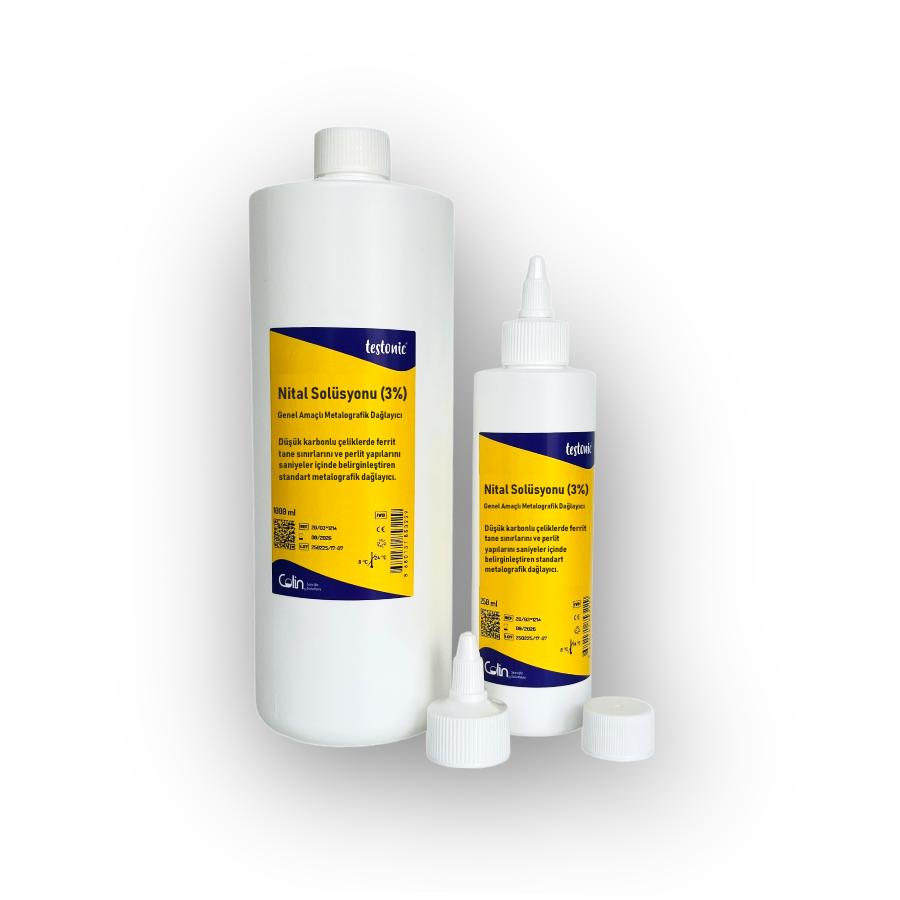
Testonic™ Nital Solution 3% is a nitric acid-alcohol based metallographic etching solution developed to help make microstructural regions more clearly visible in carbon steels and low-alloy steels.
When a polished metal specimen is examined under a microscope without etching, different phases and microstructural regions may not provide sufficient contrast. Nital promotes controlled differential attack on the polished surface, helping ferrite, pearlite, grain structure, and heat-treatment-related microstructures become easier to observe.
The 3% concentration provides a practical balance of rapid and controlled etching for routine metallographic examination of carbon and low-alloy steels.
To make the microstructure of a polished steel specimen more distinct and easier to interpret under an optical metallurgical microscope.
Why Use Nital?
In metallographic examination, obtaining a well-polished surface alone is not sufficient. Polishing produces a smooth reflective surface, but the contrast between different microstructural phases may remain limited.
Controlled etching with Nital causes different microstructural regions to react differently at the surface, helping increase phase and grain-boundary contrast under the microscope.
For this reason, Nital is one of the most widely used general-purpose etchants for steel production quality control, heat-treatment evaluation, weld examination, material investigation, and academic metallography.
Suitable for routine metallographic examination of carbon and low-alloy steels.
Helps make ferrite, pearlite, and grain structure more clearly visible under the microscope.
Facilitates examination of microstructural changes produced by heat treatment.
3% Nital provides a practical working solution for routine metallographic applications.
Which Microstructures Can Be Examined with Nital?
Nital is especially useful for producing microstructural contrast in ferrous materials. Depending on carbon content, alloy composition, and heat-treatment history, different regions become more clearly distinguishable under the microscope.
Typical structures that can be examined include ferrite, pearlite, grain boundaries, normalized or annealed structures, and microstructural regions produced by heat treatment.
This makes Nital useful both in routine production quality control and in laboratory or research investigations where rapid evaluation of the metallurgical condition of a steel specimen is required.
It is a general-purpose metallographic etchant that can be used across a broad range of microstructures in carbon and low-alloy steels. For this reason, it is commonly regarded as one of the basic etching solutions in routine metallography laboratories.
Main Applications
- Metallographic examination of carbon steels
- Microstructural analysis of low-alloy steels
- Examination of ferrite and pearlite structures
- Observation of grain structure and grain boundaries
- Microstructural control after heat treatment
- Examination after annealing and normalizing
- Weld metal and heat-affected zone examination
- Steel production quality control
- Metallurgy and materials laboratories
- University and research laboratories
- Automotive and machinery quality laboratories
- Heat-treatment facilities
- Welding and metal-processing laboratories
Product Features
| Product | Nital Solution 3% |
| Main Use | Metallographic etching of steel specimens |
| Main Material Group | Carbon steels and low-alloy steels |
| Examination Purpose | Enhancement of microstructural phase and grain contrast |
| Typical Structures | Ferrite, pearlite, grain structure, and heat-treatment-related microstructures |
| Concentration | 3% |
| Evaluation | Under a metallurgical microscope |
Nital in Heat-Treatment Evaluation
Heat treatments such as annealing, normalizing, quenching, and tempering directly change the microstructure of steel. These microstructural changes are among the key factors determining mechanical properties and service performance.
In specimens etched with Nital, contrast between microstructural regions formed during heat treatment is enhanced, making the effects of the treatment easier to evaluate under the microscope.
For this reason, Nital is widely used not only for research, but also for routine production and quality-control work in heat-treatment facilities.
Nital in Welded Joint Examination
Welding can produce different microstructures in the base metal, weld metal, and heat-affected zone.
Metallographic etching with Nital helps make the microstructural transitions between the weld region and the base metal more clearly visible.
This provides an important advantage for welding procedure evaluation, assessment of heat input effects, and quality control of welded components.
Who Is It Suitable For?
- Metallography laboratories
- Iron and steel manufacturers
- Heat-treatment companies
- Welding quality-control laboratories
- Automotive industry laboratories
- Machinery and metal-processing companies
- Materials engineering laboratories
- Universities and research centers
- Quality-control and R&D departments
- Laboratories providing metallurgical examination services
Testonic™ Metallographic Etching Solutions
Different steel types and different microstructural features may respond better to different metallographic etchants. For this reason, Nital, Picral, and Vilella provide complementary solutions for different examination requirements within the same metallography product group.
| Product | Main Material / Structure | Primary Use |
|---|---|---|
| Nital Solution 3% | Carbon and low-alloy steels | Examination of ferrite, pearlite, grain structure, and general steel microstructure |
| Picral Reagent | Carbon steels and carbide-containing structures | Enhanced examination of cementite, carbides, and ferrite-carbide structures |
| Vilella's Reagent | High-alloy, tool, and stainless steels | Examination of martensitic structures, carbides, and high-alloy steel microstructures |
Use Nital for general microstructural examination of carbon and low-alloy steels; Picral when carbide and cementite structures need to be emphasized; and Vilella for high-alloy, tool, and stainless steel microstructures.
Colin Quality and Technical Support
Testonic™ Nital Solution 3% is manufactured by Colin Kimya to provide consistent etching performance for routine metallographic examination of carbon and low-alloy steels.
Depending on the metal type, heat-treatment history, and microstructural feature to be examined, different metallographic etchants such as Nital, Picral, or Vilella may be selected. Colin's technical team can provide support in selecting the most appropriate etching solution for the application.
Technical Documents
Technical Support and Product Consulting
You can use the form to find the most suitable chemical solution for your needs or to obtain detailed information about the technical specifications of our products.
Your requests are carefully reviewed and answered by Colin's expert team.
You can ask us about the product.
