


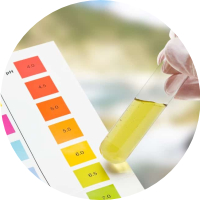
Testonic® Sulfite Test Kit – Boiler Water & Oxygen Scavenger Monitoring is designed for easy measurement of sulfite (SO₃²⁻) in boiler and process water. It provides a practical way to monitor residual sulfite levels, oxygen scavenger dosage, and water treatment processes in steam boiler systems.
Using a simple drop titration method, the kit provides a factor of 1 net drop = 5 mg/L SO₃²⁻. No electronic analytical instrument is required. Sulfite concentration is determined from the drop count after blank correction.
Sulfite Testing in 3 Simple Steps
- Collect a 5 mL water sample and add the test reagents according to the instructions.
- Add the titrant drop by drop. Count the drops until the first faint, persistent blue color appears.
- Subtract the blank drop count and multiply the net drops by 5 to calculate the sulfite concentration.
Who Can Use It?
Steam boiler operators, boiler water treatment companies, maintenance technicians, industrial water treatment professionals, and facilities monitoring residual sulfite in process water.
Package Contents
- Sulfite test reagents
- Drop titrant solution
- Testing and result interpretation instructions
Note: Sulfite can react with dissolved and atmospheric oxygen. Water samples should therefore be analyzed promptly after collection.
Sulfite Test Kit – Boiler Water and Oxygen Scavenger Monitoring
Testonic® Sulfite Test Kit is a practical drop titration kit designed to determine sulfite (SO₃²⁻) concentration in boiler water, boiler feedwater, and suitable industrial process water.
It allows monitoring of residual sulfite from oxygen scavenger chemicals, evaluation of chemical dosage changes, and routine control of water treatment processes. With a standard 5 mL sample, each net titrant drop corresponds to 5 mg/L SO₃²⁻.
Analytical Principle
The test is based on a drop-counting titration method. The water sample is prepared with the appropriate test reagents and titrated until the first faint, persistent blue color appears.
The blank titrant consumption is subtracted from the sample drop count. The net number of drops is multiplied by the kit factor to calculate the sulfite concentration in mg/L SO₃²⁻.
Why Is Sulfite Important in Boiler Water?
Dissolved oxygen is an important contributor to corrosion of metal surfaces in steam boiler systems. Oxygen scavenger chemicals, such as sodium sulfite, react with dissolved oxygen and help remove it chemically.
Sulfite is consumed during these reactions. Therefore, regular measurement of residual sulfite is useful for monitoring the effectiveness of the chemical water treatment program.
- Oxygen scavenger monitoring: Determines the residual sulfite reserve in boiler water.
- Chemical dosage control: Helps evaluate insufficient or excessive dosage.
- Corrosion management: Provides information about the oxygen scavenger treatment program.
- Blowdown and makeup water: Allows monitoring of changes caused by operating conditions.
Applications
- Steam boilers and boiler water monitoring
- Boiler feedwater treatment systems
- Sulfite-based oxygen scavenger dosage control
- Industrial water treatment and process systems
- Water monitoring before and after boiler blowdown
- Suitable sulfite residue monitoring in textile and chemical processes
Testing in 3 Steps
Transfer a safely collected 5 mL water sample into a clean test container. Add the test reagents in the specified order.
Add the titrant drop by drop while mixing. Record the count at the first faint, persistent blue endpoint.
Subtract the blank drop count and multiply the net drops by 5 to obtain the sulfite concentration in mg/L SO₃²⁻.
Technical Specifications
| Specification | Description |
|---|---|
| Product | Sulfite Test Kit |
| Measured parameter | Sulfite (SO₃²⁻) |
| Test method | Color-change drop titration |
| Standard sample volume | 5 mL |
| Drop factor | 1 net drop = 5 mg/L SO₃²⁻ |
| Titration endpoint | First faint, persistent blue color |
| Result unit | mg/L SO₃²⁻ (ppm) |
| Calculation | Blank-corrected drop count × 5 |
| Applications | Boiler water and suitable process water |
| Equipment | No electronic analytical instrument required |
Result Calculation
For a standard 5 mL water sample, the sulfite result is calculated as follows:
Sulfite (mg/L SO₃²⁻) = (Sample Drops − Blank Drops) × 5
| Sample Drops | Blank Drops | Net Drops | Sulfite Result |
|---|---|---|---|
| 3 | 1 | 2 | 10 mg/L |
| 5 | 1 | 4 | 20 mg/L |
| 7 | 1 | 6 | 30 mg/L |
Example: If 5 titrant drops are used for the sample and 1 drop for the blank, the net consumption is 4 drops. The calculated sulfite concentration is 4 × 5 = 20 mg/L SO₃²⁻.
Sulfite Result Interpretation
The target sulfite concentration depends on boiler operating pressure, feedwater quality, and the chemical treatment program. There is no single ideal sulfite concentration for every boiler system.
| Result Status | Interpretation |
|---|---|
| Below target | Residual oxygen scavenger reserve may be low. Review dosing, makeup water, and oxygen ingress. |
| Within target range | Residual sulfite is consistent with the specified water treatment target. |
| Above target | Excess chemical dosage or changes in process conditions should be evaluated. |
Sulfite, Sodium Sulfite and Sodium Metabisulfite
| Substance | Description |
|---|---|
| Sulfite (SO₃²⁻) | The ionic equivalent used to express the test result |
| Sodium Sulfite (Na₂SO₃) | An oxygen scavenger compound used in certain boiler water treatment programs |
| Sodium Metabisulfite (Na₂S₂O₅) | A different compound that can provide reducing sulfur species in suitable aqueous conditions |
Results are expressed in mg/L SO₃²⁻. When conversion to the concentration of a specific treatment chemical is required, its chemical composition and equivalent active content must be considered.
Practical Testing Notes
- Follow the facility's safe sampling procedures when collecting water from hot or pressurized boiler systems.
- Analyze water samples promptly because sulfite can react with oxygen.
- The stated drop factor applies to a standard 5 mL sample.
- Subtract blank titrant consumption when calculating results.
- Observe the color endpoint under adequate lighting.
- Other reducing or oxidizing substances may interfere in certain process water samples.
- Compare the measured value with the established boiler water treatment target.
Frequently Asked Questions
Technical Documents
Related Posts
Related News
Technical Support and Product Consulting
You can use the form to find the most suitable chemical solution for your needs or to obtain detailed information about the technical specifications of our products.
Your requests are carefully reviewed and answered by Colin's expert team.
You can ask us about the product.
