

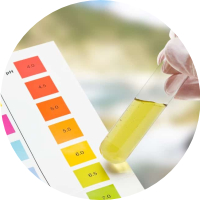
Testonic RinseCheck™ is a comparative pH-based visual test kit designed to help rapidly verify the adequacy of final rinsing after cleaning, pickling, and passivation processes on stainless steel and process equipment.
After surface treatment with acidic or alkaline process chemicals, the equipment must be rinsed sufficiently with suitable-quality water. Even when a surface appears clean, the final rinse water may still show the influence of residual process chemicals.
RinseCheck™ compares clean reference water used in the process with the final rinse water collected from the equipment. Differences between the indicator reactions of the two samples help determine whether an acidic or alkaline chemical effect is still present in the final rinse.
Has the process chemical been rinsed away sufficiently?
Why Use RinseCheck™?
The success of a surface-treatment process depends not only on the treatment itself, but also on sufficient removal of the chemicals used after the process is complete. Residual acidic or alkaline effects after pickling, passivation, or chemical cleaning may affect subsequent processing, commissioning, and surface quality.
Rather than evaluating final rinse water in isolation, RinseCheck™ provides a comparative check using the same clean water used in the facility as the reference. This helps reduce unnecessary interpretation difficulties caused by natural differences in the starting pH of water used at different facilities.
Compares clean reference water and final rinse water under the same test conditions.
Helps identify continued acidic or alkaline process-chemical influence through visible color differences.
Simplifies final rinse verification in tanks, piping, process equipment, and CIP systems.
Provides a rapid control point before equipment moves to the next stage after chemical surface treatment.
Why Compare with Reference Water?
The initial pH of rinse water may vary from one facility to another. Tap water, softened water, RO water, or other process-water sources may have different starting characteristics.
For this reason, rather than interpreting the final rinse water alone, testing the clean rinse water at the same time as a reference provides a more practical field comparison.
Because RinseCheck™ evaluates both clean reference water and final rinse water using the same indicator system, an acidic or alkaline shift caused by residual process chemicals can be identified easily through the color difference between the two samples.
The objective is not simply to obtain a single pH value, but to rapidly and visually determine how closely the final rinse water has returned to the condition of the clean water used in the process.
Why Is Final Rinse Verification Important?
Acidic chemicals may be used during pickling and passivation, while alkaline products may be used in certain cleaning processes. After treatment, these chemicals must be removed from the equipment and internal surfaces by sufficient rinsing.
Evaluating rinsing only by a fixed time or by the volume of water used may not always reflect actual rinse performance, especially with different equipment geometries and process conditions. Tank bottoms, connections, dead legs, piping, and complex equipment geometry can all influence rinsing efficiency.
RinseCheck™ helps verify directly whether the final rinse water has approached the condition of the clean reference water, supporting a more systematic field evaluation of the rinsing process.
Main Applications
- Final rinse verification of stainless steel tanks and reactors
- Rinsing after pickling
- Rinsing after passivation
- Verification after acidic surface cleaning
- Verification after alkaline cleaning
- Stainless steel piping and process lines
- CIP systems
- Food and beverage processing equipment
- Pharmaceutical production equipment
- Chemical and process plants
- Commissioning of newly fabricated equipment
- Rinse verification after maintenance and chemical cleaning
- Pickling and passivation service providers
Product Features
| Control Purpose | Verification of final rinsing with respect to acidic or alkaline process-chemical influence |
| Samples | Clean reference water and final rinse water |
| Test Approach | Comparative pH indicator reaction |
| Result | Visual comparison of the color reactions of the two water samples |
| Main Use | Final rinse control after cleaning, pickling, and passivation |
| Evaluation | Visual comparison |
| Instrument Requirement | No instrument required |
What Does It Provide in Production?
Instead of relying only on a fixed rinse time, actually checking the final rinse water allows the facility to make decisions based on the real condition of the process.
RinseCheck™ is particularly useful in large equipment or processes operating with different volumes, helping provide a rapid field answer to the question: “Is another rinse cycle necessary?”
This approach can help reduce unnecessary rinse cycles, support more controlled process-time management, and make commissioning decisions after surface treatment more systematic.
Who Is It Suitable For?
- Stainless steel tank and equipment manufacturers
- Pickling and passivation service providers
- Stainless steel piping companies
- Food processing equipment manufacturers
- Pharmaceutical equipment manufacturers
- Chemical and process equipment manufacturers
- Facilities operating CIP systems
- Quality control and quality assurance departments
- Maintenance and technical service teams
- Commissioning and field inspection teams
Testonic™ Post-Surface-Treatment Control Flow
Within the Testonic™ surface quality-control product range, RinseCheck™ is the product designed to verify the rinsing stage. After surface treatment, the first question is whether the process chemical has been sufficiently rinsed away; when required, the metal surface itself can then be evaluated with other Testonic™ tests.
| Control Stage | Testonic™ Product | Main Control Question |
|---|---|---|
| Verify the final rinse | RinseCheck™ | Has the process chemical been rinsed away sufficiently? |
| Verify the general surface | PassiCopper™ | Does reactive free iron remain on the surface? |
| Verify the surface extract | PassiFerro™ | Is extractable iron residue present on the surface? |
| Verify critical localized areas | Ferro-Check™ | Is localized free iron present at a weld or other suspicious area? |
After surface treatment, first verify the final rinse with RinseCheck™. When required, continue with PassiCopper™, PassiFerro™, or Ferro-Check™ to evaluate the metal surface itself.
Colin Quality and Technical Support
Testonic RinseCheck™ is manufactured by Colin Kimya to provide rapid and practical field verification of the final rinse stage after cleaning, pickling, and passivation processes.
RinseCheck™ provides a practical final-rinse control solution for stainless steel equipment manufacturers, pickling and passivation service providers, and quality teams carrying out controlled commissioning of process equipment.
Where both rinsing and surface quality verification are required after surface treatment, RinseCheck™ can be used together with PassiCopper™, PassiFerro™, and Ferro-Check™ as complementary stages of the same quality-control process. Colin's technical team can provide support in selecting the most appropriate products for the application.
Technical Documents
Technical Support and Product Consulting
You can use the form to find the most suitable chemical solution for your needs or to obtain detailed information about the technical specifications of our products.
Your requests are carefully reviewed and answered by Colin's expert team.
You can ask us about the product.