How to Select the Right Test for Metal Analysis and Surface Control
Quick Summary
A single test cannot answer every question in metal quality control. Whether the material is the correct stainless steel grade, whether free iron remains on the surface after passivation, whether process chemicals have been sufficiently rinsed away, whether corrosion-related iron is present in system water, and what the metal microstructure looks like are evaluated using different control methods. The Testonic metal analysis and surface control product range provides suitable field and laboratory solutions for each of these stages.
Contents
Why Are Different Tests Used in Metal Quality Control?
Different questions must be answered when evaluating the quality of a stainless steel tank, pipeline, process equipment, or metal component.
For example, determining whether a component is 304 or 316 stainless steel is a material verification issue. The presence of free iron on the surface after passivation is a surface quality issue. Residual acidic or alkaline treatment chemicals in the final rinse water are a rinsing control issue. Iron appearing in system water after commissioning, on the other hand, may be related to corrosion monitoring.
The Metal Quality Control Chain
The easiest way to understand the Testonic product family is to consider the life cycle of metal equipment as a quality control chain.
Confirm that the stainless steel used is the correct grade.
Evaluate free iron and localized active areas after passivation.
Check whether process chemicals have been sufficiently removed from the system.
Track corrosion-related iron in process or system water during operation.
Use metallographic etching when microscopic structural examination is required.
1. Is the Material Correct? — Stainless Steel Grade Identification Tests
One of the first steps in quality control is to verify whether the stainless steel received or used in production corresponds to the specified grade. Stainless steels with similar surface appearance often cannot be reliably distinguished by visual inspection alone.
| Control Requirement | Recommended Product | Main Question |
|---|---|---|
| 201 / 304 differentiation | Stainless Steel Grade Identification Test Kit – 201/304 | Is the material 201 or 304? |
| 303 / 304 differentiation | Stainless Steel Grade Identification Test Kit – 303/304 | Is the material 303 or 304? |
| 304 / 316 differentiation | Stainless Steel Grade Identification Test Kit – 304/316 | Is the material 304 or 316? |
These tests can be used as rapid screening tools during incoming material inspection, warehouse checks, production, installation, maintenance, and field verification.
2. How Is the Surface Checked After Passivation?
The corrosion performance of stainless steel does not depend only on alloy grade. Welding, grinding, mechanical processing, contact with carbon steel, or maintenance activities may introduce foreign iron onto the surface. For this reason, free iron and active surface areas should be evaluated after surface treatment.
PassiCopper™ – Copper Sulfate Passivation Test Solution
PassiCopper™ is intended to help evaluate reactive free iron directly on a passivated stainless steel surface using a copper sulfate-based surface reaction.
Does reactive free iron remain on the surface after passivation?
PassiFerro™ – Iron Residue Test Kit
PassiFerro™ uses a different approach. Instead of relying solely on a direct surface reaction, iron residue is evaluated in an extract obtained from the metal surface.
Is extractable iron residue present on a defined metal surface area?
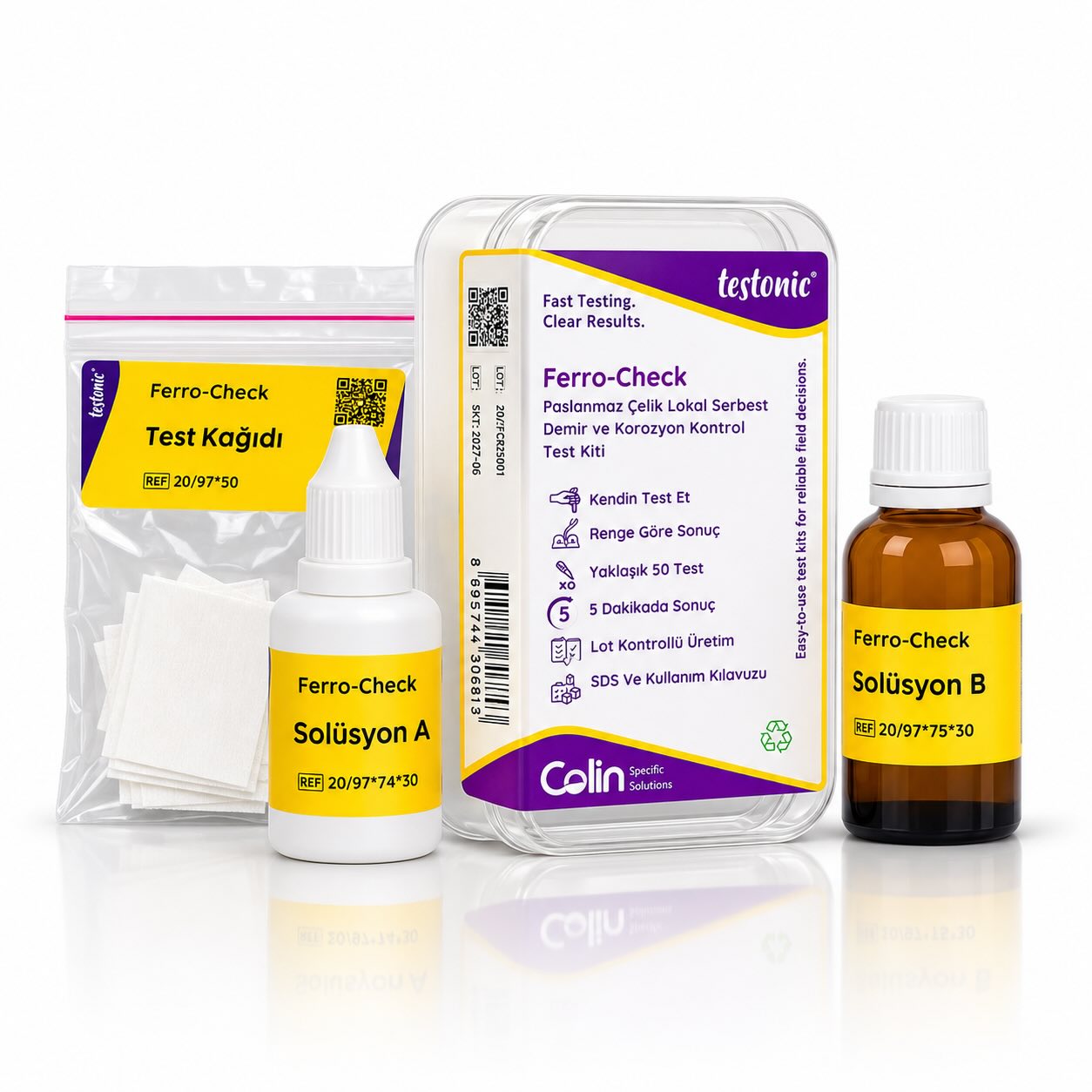
Ferro-Check™ – Ferroxyl-Based Local Free Iron and Passivation Surface Control Kit
Ferro-Check™ is a ferroxyl-based localized surface test used to identify areas associated with free iron, iron oxide residues, or active corrosion. It is particularly useful for welds, joints, ground areas, and other suspicious localized surface regions.
Is there an active iron or localized corrosion-related area on the surface?
3. Have the Process Chemicals Been Sufficiently Rinsed Away?
RinseCheck™ – Post-Passivation Rinse pH Control Kit
After pickling, acid cleaning, passivation, or neutralization, the chemicals used during treatment must be sufficiently removed from the system.
RinseCheck™ compares the pH response of clean reference water with that of the final rinse water collected from the system. This makes it possible to visually evaluate whether acidic treatment chemicals or alkaline neutralizing agents are still influencing the final rinse.
Have the chemicals used during pickling, passivation, or neutralization been sufficiently rinsed away?
4. How Can Corrosion Be Monitored During Operation?
FerroAlert™ – Iron and Corrosion-Related Iron Control Kit for Water Samples
Once metal equipment is in operation, monitoring changes in iron concentration in process or system water can help investigate developing corrosion or internal sources of iron.
FerroAlert™ is designed for colorimetric iron control in water samples taken from process lines, tanks, piping systems, boilers, cooling circuits, and CIP systems.
Where possible, comparing clean inlet water with a sample taken from the system helps distinguish iron already present in the incoming water from an increase that may originate within the system.
Is there an increase in iron in system or process water that may be associated with rust or corrosion?
5. How Is the Metal Microstructure Examined?
Field quality-control tests cannot answer every question. When investigating material failure, weld structure, heat treatment, phase distribution, carbides, or grain structure, metallographic sample preparation and microscopic examination may be required.
Nital Solution (3%) – General-Purpose Metallographic Etchant
Nital is a widely used metallographic etchant, particularly for carbon steels and low-alloy steels. It can help reveal ferrite-pearlite structures and related microstructural features for microscopic examination.
Picral Reagent – High-Resolution Metallographic Etching Solution
Picral is used to reveal selected carbide structures, grain boundaries, and other metallographic details. It should not automatically be treated as interchangeable with Nital; selection depends on the alloy and the microstructural feature being investigated.
Vilella’s Reagent – Metallographic Etchant for High-Alloy and Stainless Steels
Vilella’s Reagent is a metallographic etchant used for high-alloy steels, tool steels, and suitable stainless steel applications. It can help reveal martensitic structures and selected carbide formations.
Stellite-Etch – Surface Activation Solution for CoCrW Superalloys
Stellite-Etch differs from conventional stainless steel passivation tests and general-purpose metallographic etchants. It is intended for special alloy surface treatment applications, particularly the removal of surface oxides and preparation of CoCrW and similar alloy surfaces for subsequent processing.
Which Testonic Product Should I Choose?
The most reliable starting point is not the product name but the quality-control question that needs to be answered.
| Control Question | Sample / Control Area | Recommended Product |
|---|---|---|
| Is this stainless steel 201 or 304? | Metal surface | 201/304 Grade Identification Kit |
| Is this stainless steel 303 or 304? | Metal surface | 303/304 Grade Identification Kit |
| Is this stainless steel 304 or 316? | Metal surface | 304/316 Grade Identification Kit |
| Does reactive free iron remain on the surface after passivation? | Direct stainless steel surface | PassiCopper™ |
| Is extractable iron residue present on the surface? | Metal surface extract | PassiFerro™ |
| Is there a localized active iron or corrosion-related area? | Direct local metal surface | Ferro-Check™ |
| Have process chemicals been sufficiently rinsed away? | Clean reference water + final rinse water | RinseCheck™ |
| Is there an increase in corrosion-related iron in system water? | Process / system water | FerroAlert™ |
| What does the steel microstructure look like? | Polished metallographic sample | Nital / Picral / Vilella’s Reagent |
| Does a CoCrW-type special alloy surface need preparation for further processing? | Special alloy surface | Stellite-Etch |
Example: How Can a Stainless Steel Process Tank Be Quality-Controlled?
Consider a newly manufactured stainless steel process tank.
Can These Tests Be Used Interchangeably?
No. One of the most important distinctions is that the products evaluate different sample types and answer different quality-control questions.
| Product | What Does It Evaluate? |
|---|---|
| RinseCheck™ | Final rinse water |
| PassiFerro™ | Extract obtained from the metal surface |
| PassiCopper™ | Direct stainless steel surface |
| Ferro-Check™ | Localized metal surface |
| FerroAlert™ | System or process water |
Frequently Asked Questions
Conclusion
The correct approach to metal quality control is not to apply one product to every problem, but to define the parameter to be controlled correctly and select the appropriate test method.
The Testonic Metal Analysis and Surface Control product family provides solutions for different stages of quality control, from material verification and passivation control to final-rinse verification, corrosion monitoring, and metallographic examination.
The Right Test Starts with the Right Control Question
Explore the Metal Test Kits category to select the appropriate Testonic solution for material grade verification, passivation, free iron, rinsing, corrosion, or metallography applications.
Explore Metal Test Kits